
SEF Toolkit Map
Overview
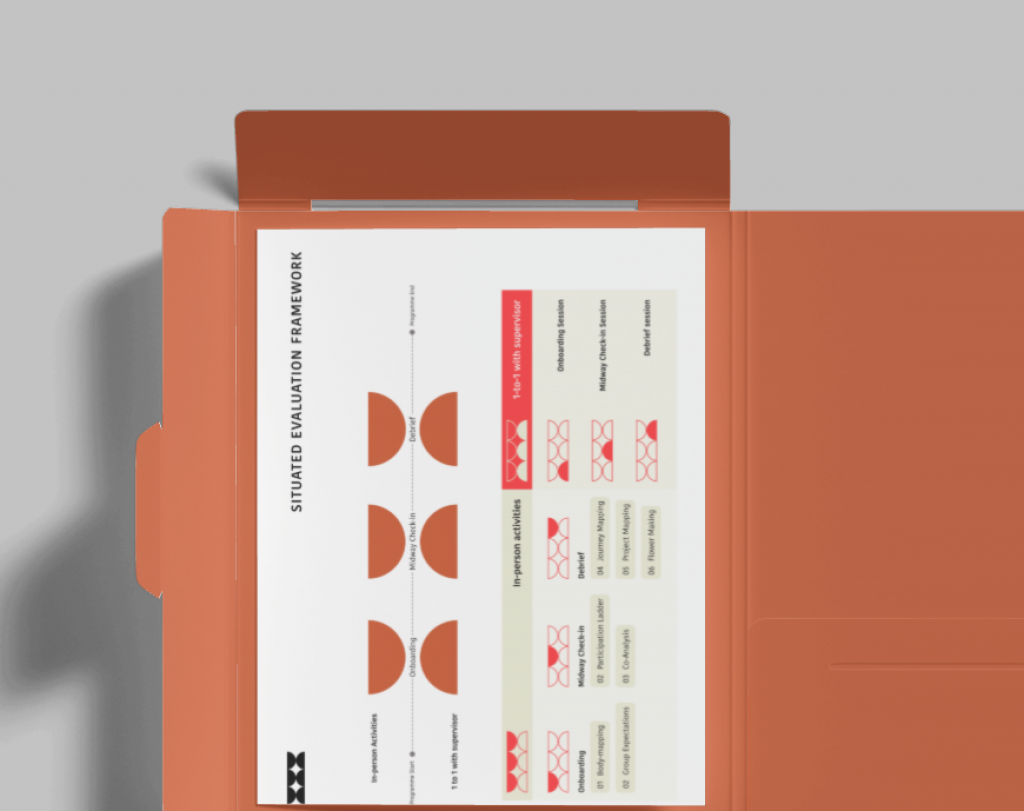
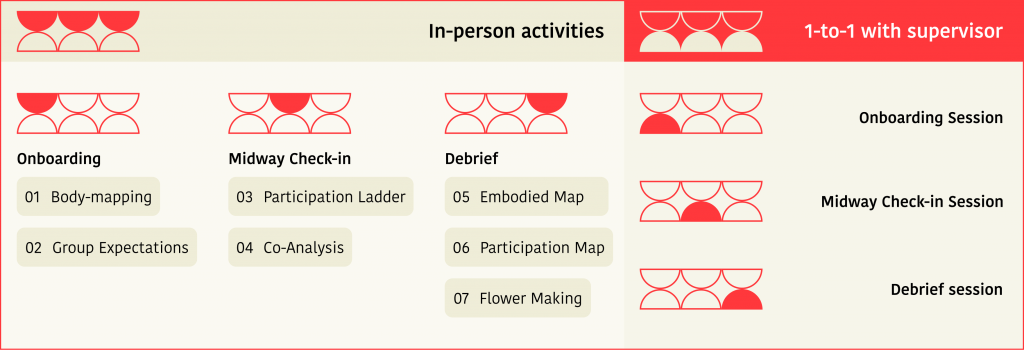
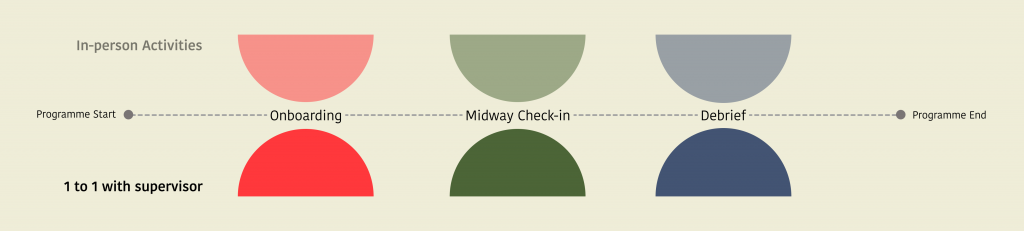
The framework consists of In-Person Activities, designed for student partners to facilitate autonomously or in collaboration with an external partner-facilitator, and One-to-One Supervision Activities, facilitated by the student partners’ supervisor to support reflection, documentation, and ongoing evaluation.
Glossary
Accessibility
Designing and adapting activities, environments, and participation structures to support different access needs, communication preferences, identities, abilities, and ways of engaging.
Co-Analysis
A collaborative process where participants collectively interpret reflections, experiences, stories, tensions, and insights generated throughout the evaluation process. Co-analysis recognises meaning-making as relational and shaped through dialogue and multiple perspectives.
Collective Meaning-Making
The shared process of interpreting experiences, identifying patterns, and developing understanding through discussion, reflection, storytelling, and collaborative analysis.
Collective Care
Practices of support, attentiveness, accountability, and wellbeing that recognise the interconnected needs of individuals and communities within collaborative work.
Facilitation Guide
The Situated Evaluation Framework (SEF) is grounded in principles of care, collaboration, accessibility, reflexivity, and respect for lived experience. Many of the activities within this framework invite participants to reflect on personal experiences, relationships, emotions, institutional dynamics, participation, and social justice work. As such, ethical and facilitation considerations should remain central throughout the evaluation process.
This framework does not approach evaluation as a neutral or extractive process. Instead, it recognises that reflection, storytelling, dialogue, and collaborative analysis can involve vulnerability, power dynamics, emotional labour, and differing experiences of participation and institutional life. Facilitators and participants are therefore encouraged to approach all activities with care, flexibility, and attentiveness to individual and collective wellbeing.
Facilitating
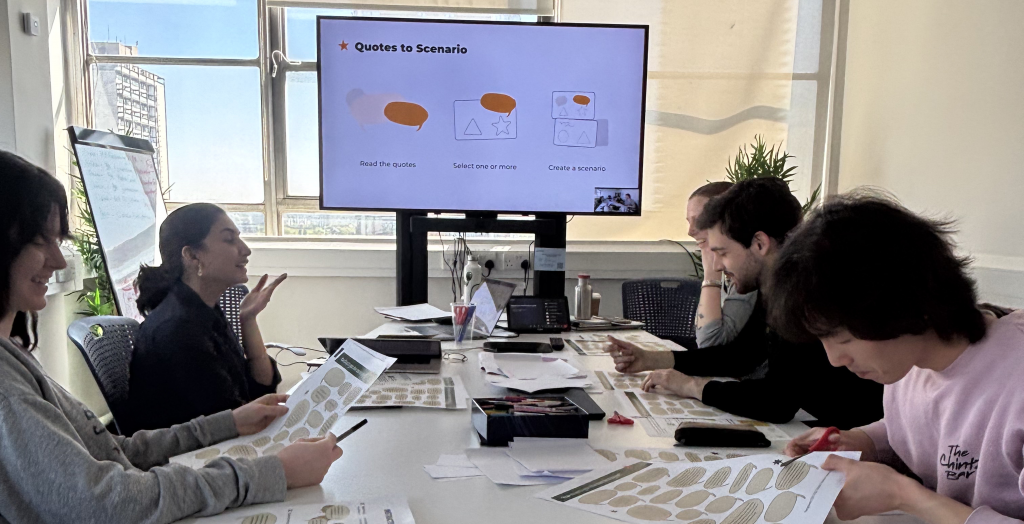
Across all activities within the framework, facilitators should aim to create supportive, respectful, and non-judgemental environments that encourage meaningful and brave participation while recognising that participants may have different communication preferences, comfort levels, identities, experiences, and access needs. Facilitators should:
- Encourage participants to engage in ways that feel comfortable and accessible to them,
- Recognise that there are no “correct” responses, interpretations, or forms of participation,
- Support multiple forms of expression, including verbal, written, visual, symbolic, or abstract responses,
- Avoid interpreting participants’ experiences, drawings, stories, or reflections on their behalf,
- Encourage active listening, mutual respect, and collaborative dialogue,
- Be attentive to power dynamics within groups and institutional contexts,
- Allow space for pauses, silence, reflection, and emotional processing,
- Prioritise care, wellbeing, and collective support over polished outputs or productivity,
- Encourage critical reflection while remaining constructive and future-oriented,
- Support accessibility and flexibility throughout activities wherever possible.
Facilitators should also recognise that they are part of the reflective and relational process rather than neutral observers outside of it.
Privacy and transparency
Participants should be informed about how reflections, outputs, photographs, quotes, or observations may be documented, shared, or used within programme evaluation, presentations, reports, or future development work. Facilitators should:
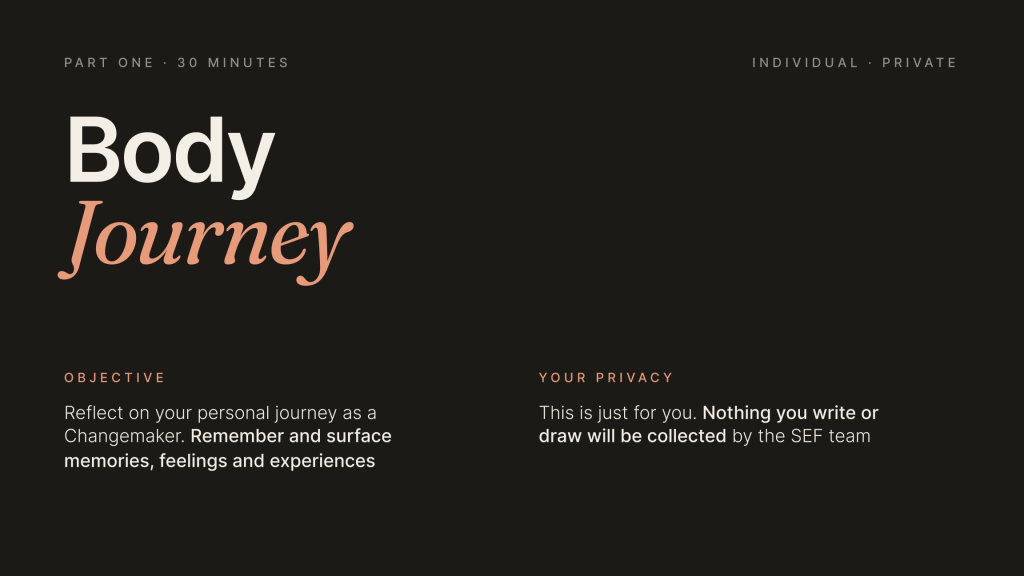
- seek consent before documenting or photographing outputs,
- avoid attributing sensitive reflections or quotes without permission,
- anonymise materials where appropriate,
- communicate clearly about how documentation will be stored or shared, as well as if something will not be documented and why,
- respect participants’ decisions not to share or document aspects of their work,
- remind participants that sharing personal experiences is always voluntary,
- avoid pressuring participants to disclose personal or sensitive experiences,
- define what a “brave or safe space” means instead of assuming everyone is on the same page,
- encourage participants to collectively create rules for privacy, defining what remains within the room and what goes out.
Participants should also be reminded that confidentiality within group discussions should be respected wherever possible.Facilitators should also recognise that they are part of the reflective and relational process rather than neutral observers outside of it.
Heuristics
Participants should understand the intent behind each activity.
Participants should be provided with a range of prompt formats like written, verbal and visual, to effectively understand the activities. Facilitators should communicate the intent behind each activity.
Cognitive Effort
Participants are also giving their energy along with their time. Facilitators should consider the cognitive effort of each activity within one session. Provide appropriate breaks and support that can help participants during the activity. For example, during a reflective activity, participants can be given quotes or artefacts they previously created in another reflective session.
Inclusivity and accessibility
The framework is intended to be adapted according to the needs, contexts, and access requirements of participants. Facilitators are encouraged to consider accessibility throughout planning and delivery, including:
- offering multiple ways to participate,
- adapting timings, spaces, and activities where needed,
- considering sensory, physical, linguistic, and communication access,
- creating flexible participation structures,
- recognising different forms of knowledge, experience, and expression.
Facilitators should also remain attentive to how institutional, cultural, social, and interpersonal dynamics may shape participation and inclusion within group settings.
Documentation
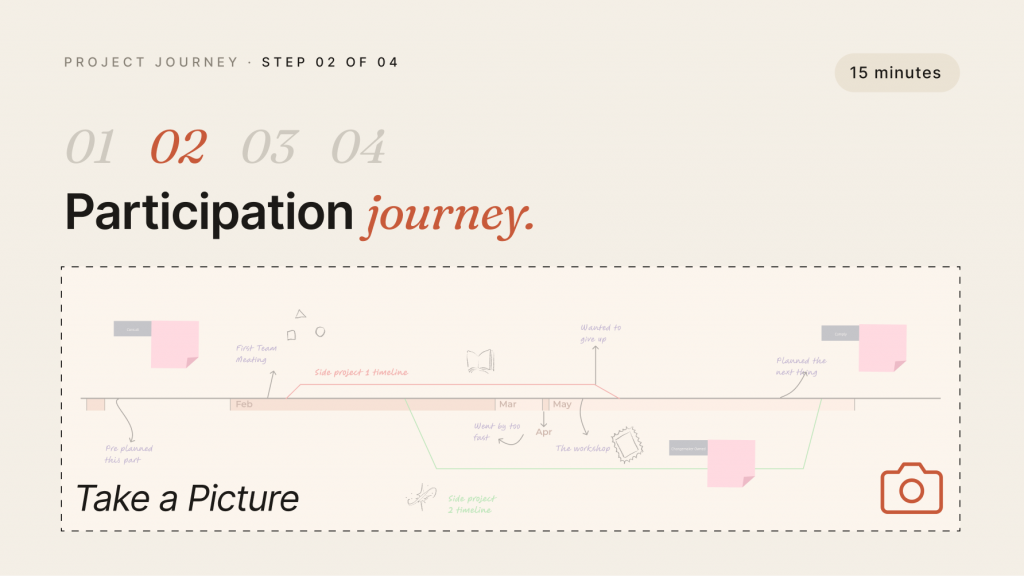
Facilitators are encouraged to build the process documentation into the design of the activity, so they can focus entirely on facilitation without having to worry about writing notes or taking pictures. For example, participants could be asked to write summary notes or take pictures of their own creation to be shared with the facilitator later.
Carbon Usage
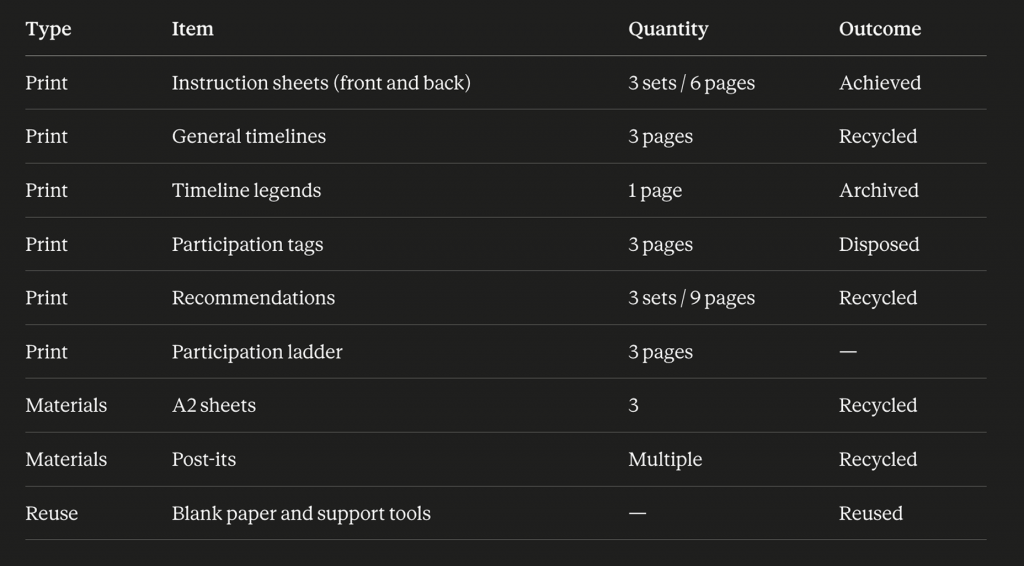
Facilitators should consider how much waste is produced during each activity and are encouraged to continually reflect and ideate on eco-friendly ways of running the sessions. Facilitators should maintain detailed documentation of materials printed, used, recycled or discarded for each activity, so it can be reviewed and reflected upon.
Care and Reflexivity
Many activities within this framework involve critical reflection on participation, collaboration, institutional experiences, and social change work. These conversations may surface tensions, frustrations, emotional responses, or experiences of exclusion and inequity.
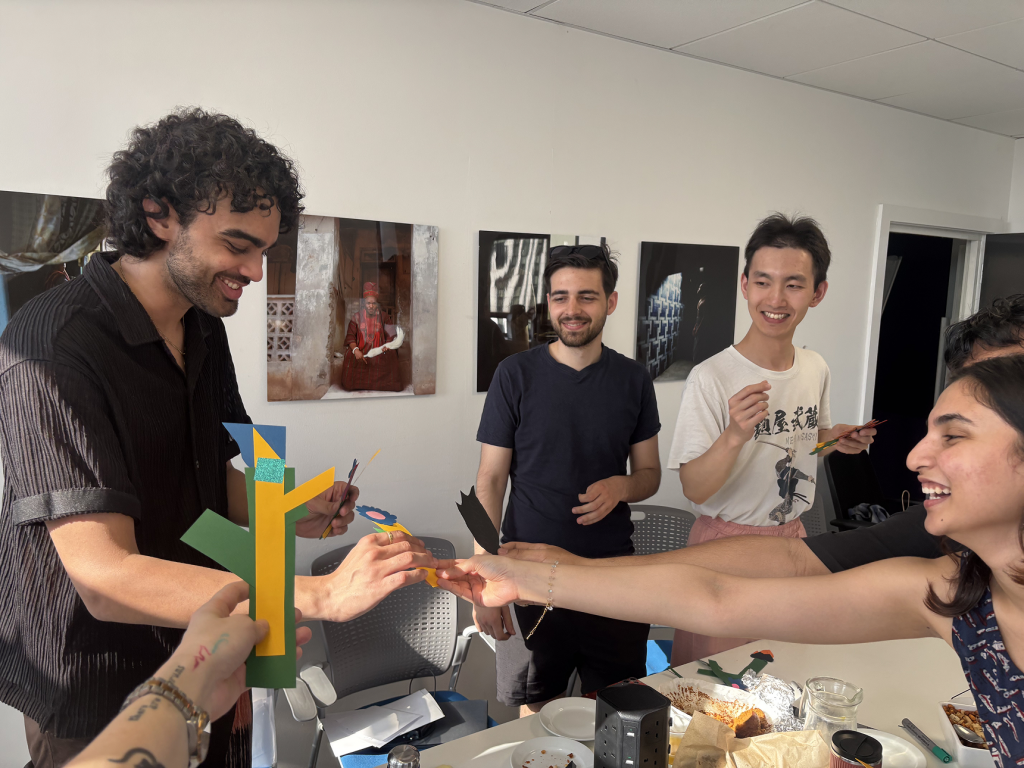
Facilitators should approach these moments with care, openness, and reflexivity. This includes recognising their own positionality, assumptions, and role within the facilitation process, while remaining responsive to the needs and wellbeing of participants.
The framework encourages facilitators and participants to approach evaluation not as a process of judgement or performance measurement, but as an opportunity for dialogue, collective learning, reflection, and transformation.
Because the framework is intended to evolve through practice, facilitators and participants are encouraged to adapt activities, methods, and approaches in ways that best support ethical, inclusive, and meaningful engagement within their own communities and institutional contexts.

In-Person Activities
This in-person evaluation process is organised across three interconnected stages designed to support reflection, dialogue, learning, collective meaning-making, and celebration throughout the student partners’ journey.
The activities are intended to be carried out independently from supervisors, either self-facilitated by student partners or supported by an external partner-facilitator. Where possible, it is encouraged that facilitation is led by previous student partners, as this can support the continuation of practice across cohorts, strengthen community-building, and create opportunities for peer learning and professional development.
The process offers structured moments to pause, take stock, and engage with peers while making meaning of personal and collective experiences. These sessions are analogue by design, grounded in creative and collaborative practices that foster trust, care, and depth of insight.
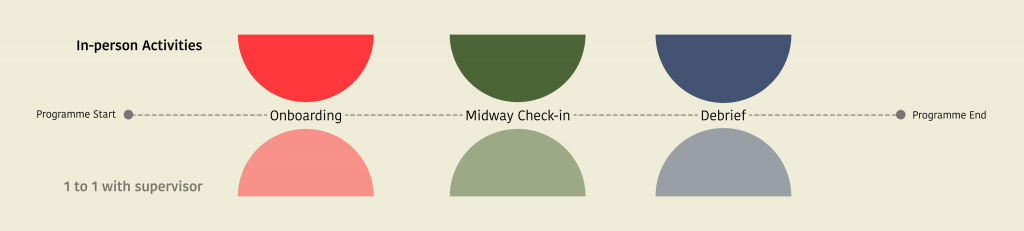
The activities are organised across three key stages of the student partners’ journey:

Onboarding
This phase welcomes student partners and builds a foundation of trust and shared purpose. Activities focus on exploring individual identities and setting group expectations.

Midway Check-in
Student partners reflect on participation, engagement, and collective dynamics while identifying opportunities for deeper involvement and collaboration. They also collectively interpret experiences, identify recurring themes, explore challenges and enablers, and develop recommendations for possible future actions.

Debrief
The closing phase offers space to celebrate achievements and reflect on the overall journey. It supports collective feedback and meaningful evaluation of the programme’s impact.
Each phase — Onboarding, Midway Check-in, Co-Analysis, and Debriefing — features tailored reflective, visual, dialogic, and creative methods to help participants explore their positionality, growth, challenges, relationships, and impact.
These connected activities guide student partners through the programme with space for reflection, feedback, and celebration.

Onboarding
The Onboarding stage marks the beginning of the student partners’ journey.
This stage is designed to help participants feel welcomed, grounded in a shared purpose, and connected to the wider programme community. It also creates space for participants to reflect on their positionality, recognising that each student partner brings unique experiences, perspectives, identities, and forms of knowledge that enrich the collective work.
01
Body-mapping
02
Group Expectations
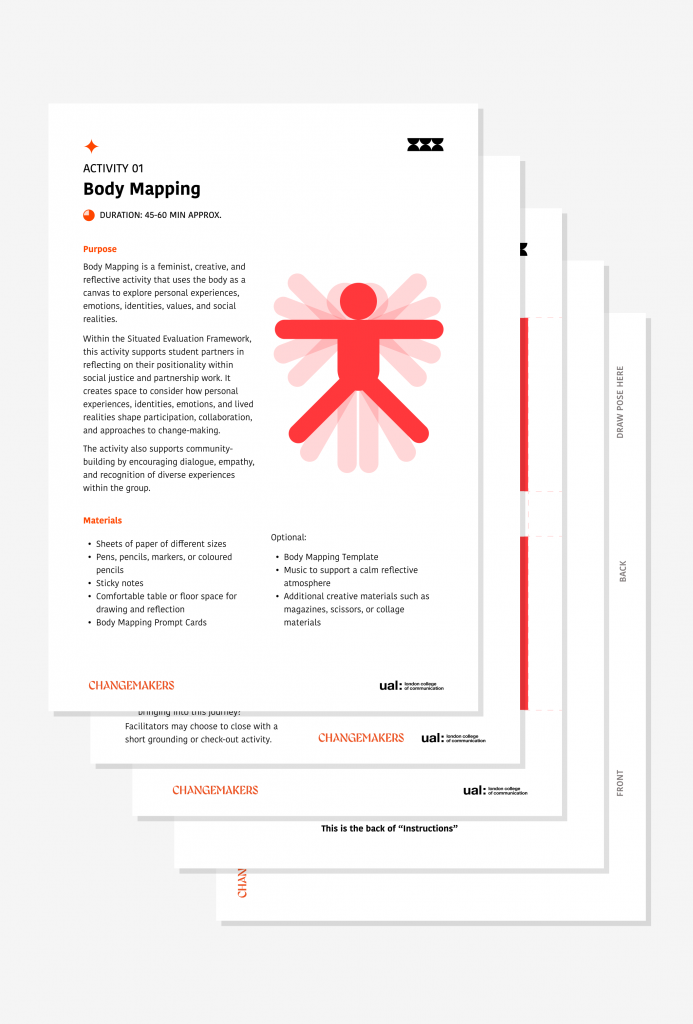
Activity 01: Body Mapping

Activity 01
Body Mapping

Duration: 45-60 min Approx.
Purpose
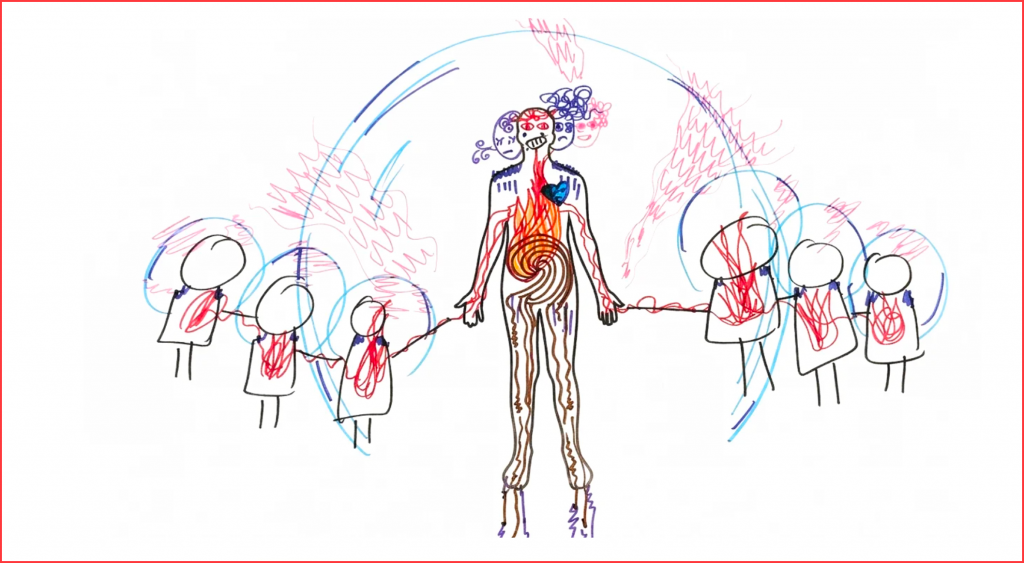
Body Mapping is a feminist, creative, and reflective activity that uses the body as a canvas to explore personal experiences, emotions, identities, values, and social realities.
Within the Situated Evaluation Framework, this activity supports student partners in reflecting on their positionality within social justice and partnership work. It creates space to consider how personal experiences, identities, emotions, and lived realities shape participation, collaboration, and approaches to change-making.
The activity also supports community-building by encouraging dialogue, empathy, and recognition of diverse experiences within the group.

Materials
- Sheets of paper of different sizes
- Pens, pencils, markers, or coloured pencils
- Sticky notes
- Comfortable table or floor space for drawing and reflection
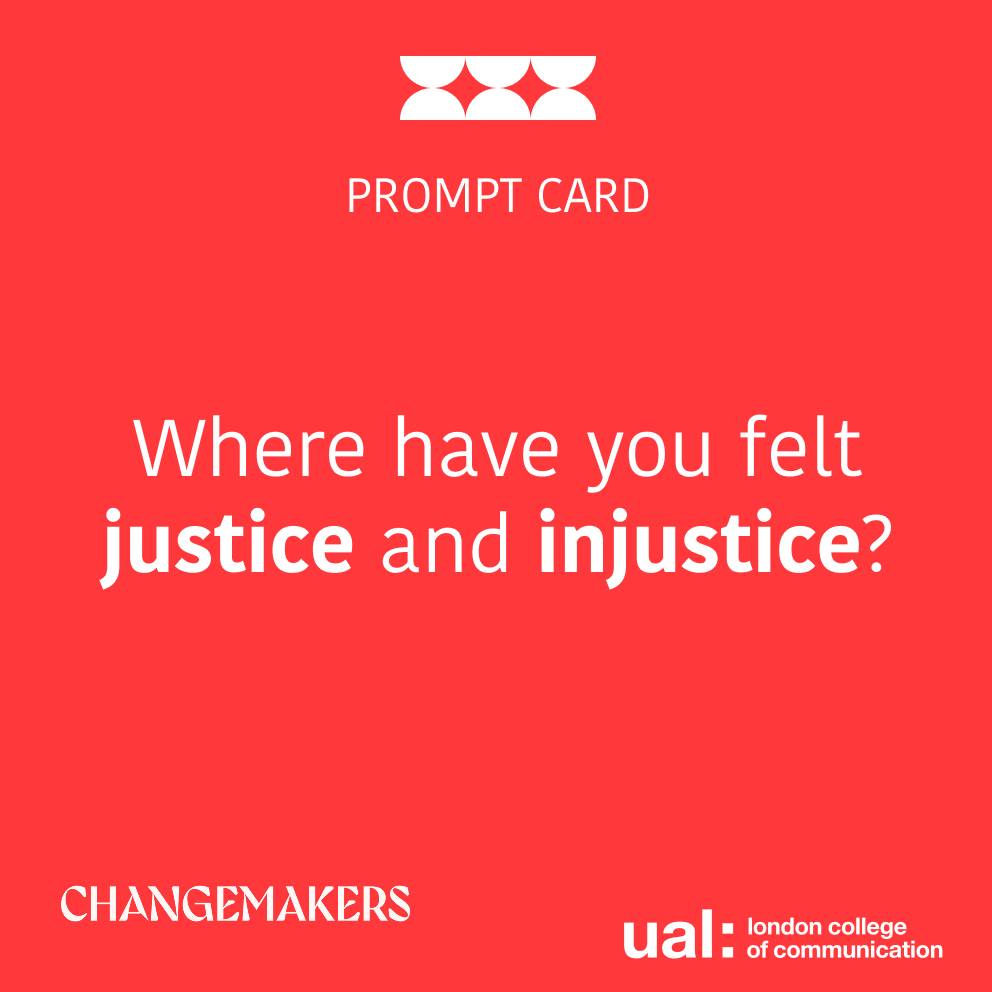
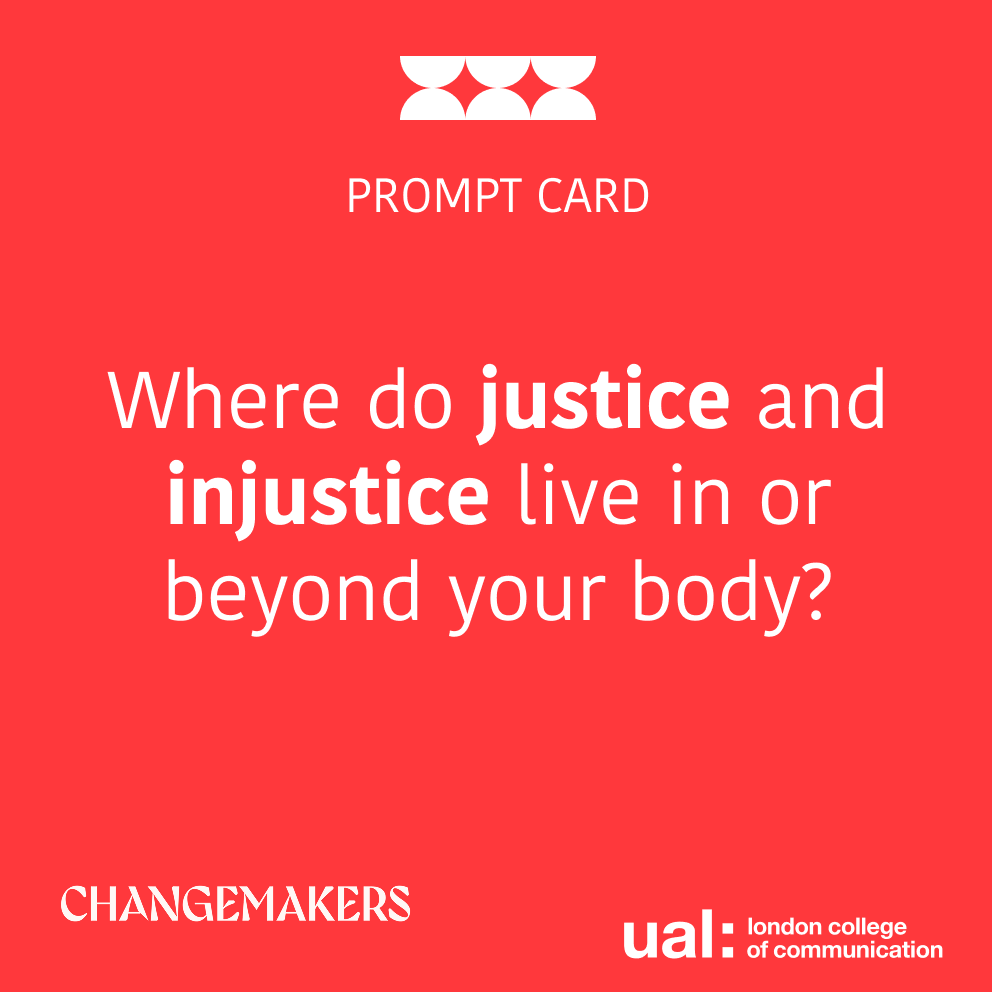
- Body Mapping Prompt Cards
Optional:
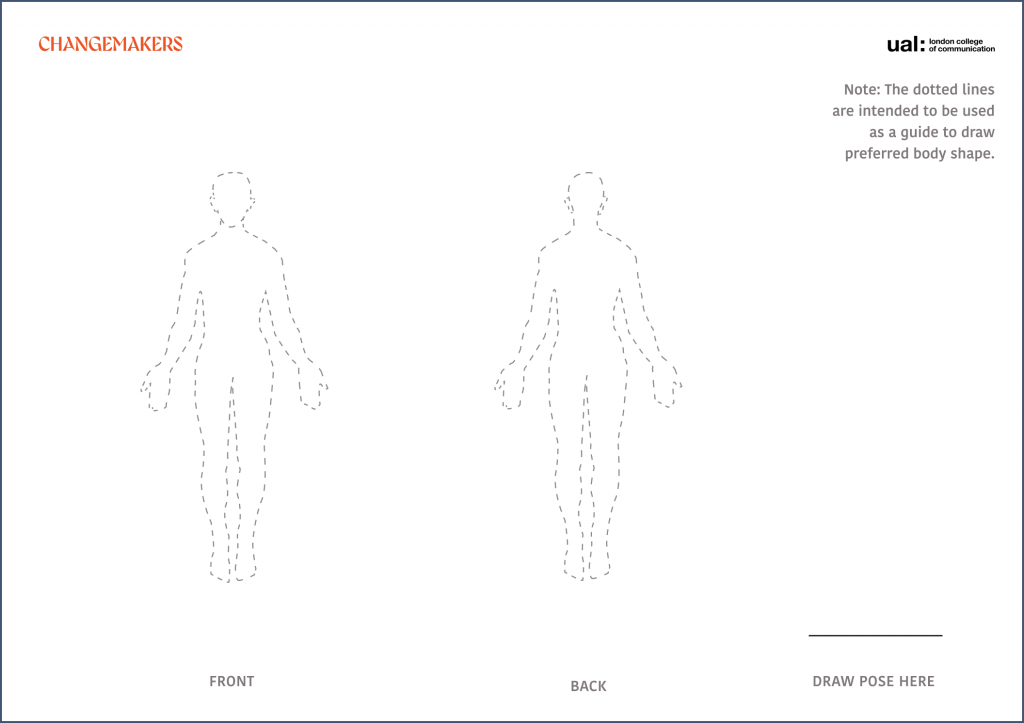
- Body Mapping Template
- Music to support a calm reflective atmosphere
- Additional creative materials such as magazines, scissors, or collage materials
Instructions

Step 01: Draw Your Body

Duration: 5-10 min Approx.
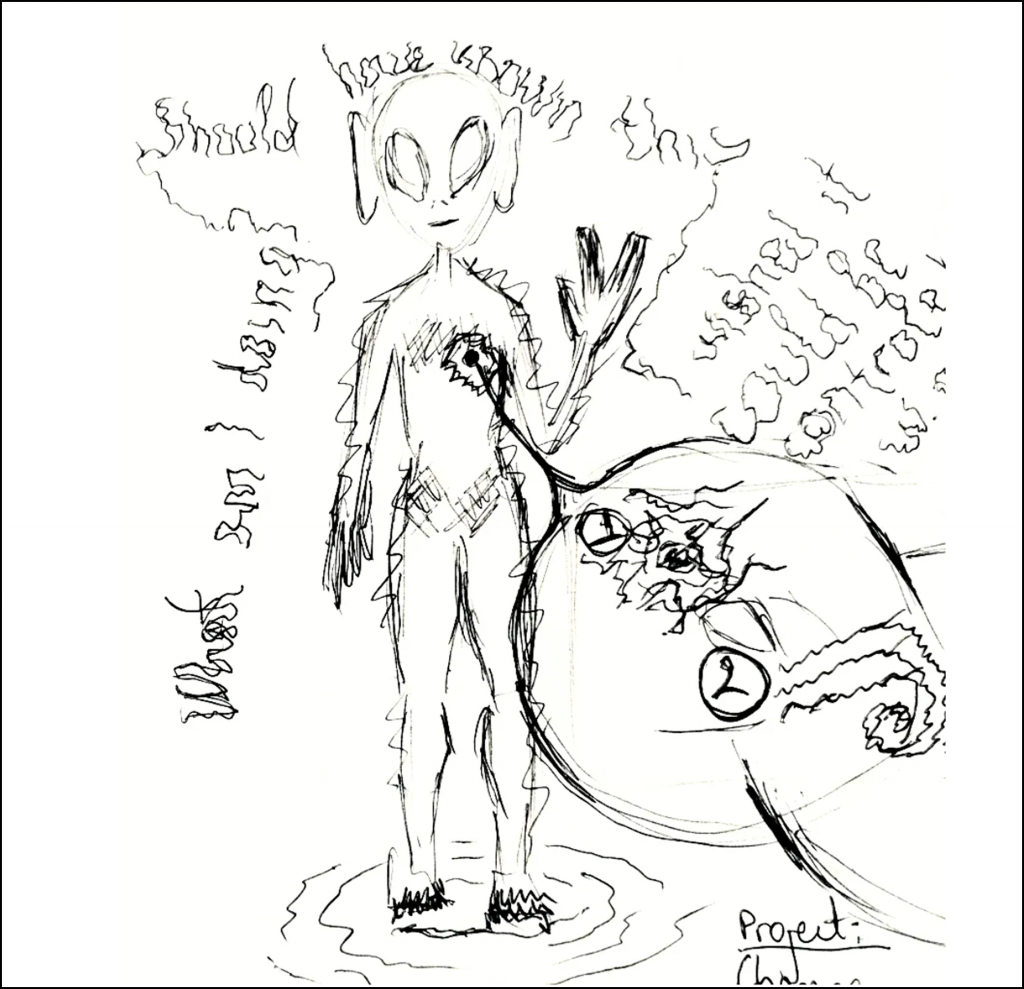
Invite participants to sketch a simple outline of their body in any style or form that feels comfortable to them. Participants may use a full-body outline, abstract representation, or symbolic shape.

Step 02: Respond to the Prompt Cards

Duration: 15-20 min Approx.
Using colours, words, drawings, symbols, or collage materials, invite participants to respond to the prompt cards and reflect on:
- experiences they carry into this work,
- emotions connected to the programme,
- values, motivations, or identities,
- sources of strength, challenge, or care,
- relationships to community, learning, or change-making.
Participants may work quietly and independently during this stage.

Step 03: Reflection and Optional Sharing

Duration: 20-30 min Approx.
Invite participants to reflect individually or discuss aspects of their body maps with the group. Sharing should remain voluntary.
Possible reflection prompts:
- What did you notice while creating your body map?
- What experiences or values feel most present in your work?
- How do your experiences shape the way you participate in this programme?
- What strengths or challenges are you bringing into this journey?
Facilitators may choose to close with a short grounding or check-out activity.
Outputs
This activity may generate:
- Individual body maps,
- Personal reflections and narratives,
- Shared themes emerging across the group,
- Insights into participants’ positionalities, motivations, values, and experiences,
- Greater understanding and connection within the group.
Where appropriate and with participants’ consent, facilitators may document recurring themes, anonymous quotes, or photographs of the body maps to support collective reflection and programme evaluation.
Activity 02: Group Expectations
Activity 03
Group Expectations

Duration: 30-40 min Approx.
Purpose
The Group Expectations activity creates space for student partners to collaboratively establish shared expectations, values, and ways of working at the beginning of the programme.
The activity supports trust-building, collective care, accountability, and open communication by encouraging participants to reflect on what they need in order to feel supported, respected, and able to participate meaningfully within the group.
It also helps establish a shared foundation for collaboration throughout the programme and contributes to creating a more inclusive and supportive learning environment.

Materials
- Large sheets of paper
- Sticky notes
- Pens and markers
Optional:
- Printed reflection prompts
Instructions

Step 01: Individual Reflection

Duration: 5 min
Invite participants to reflect individually on their hopes, expectations, and intentions for the programme.
Possible prompts:
- What do you hope to gain or experience through this programme?
- What would help you feel supported within this group?
- What values or behaviours are important to you in collaborative work?
- What does a positive group environment look like to you?
Participants may write their reflections on sticky notes or directly onto paper.

Step 02: Group Sharing and Discussion
Duration: 15-20 min
Invite participants to share and discuss their reflections with the group.
Facilitate discussion around shared values, expectations, communication styles, boundaries, accountability, and collective care. Encourage participants to notice common themes, differences, and priorities emerging within the conversation.
Possible discussion prompts:
- What values should guide this group throughout the programme?
- How would we like to communicate and collaborate with one another?
- What helps people feel included, respected, and heard?
- How should the group respond to challenges or disagreements?

Step 03: Collective Agreements

Duration: 10-15 min
Work together to identify and document a set of shared group expectations or collective agreements.
Facilitators may choose to:
- write agreements onto a shared poster,
- create a collaborative document,
- group similar ideas together,
- prioritise key commitments as a group.
Encourage participants to revisit and adapt these agreements throughout the programme if needed.
Outputs
This activity may generate:
- A shared set of group expectations or collective agreements,
- Greater clarity around communication, participation, and collaboration,
- Increased trust and understanding within the group,
- Shared values and commitments to support collective care and accountability.
Facilitators may document the agreed expectations in a shared format that can be revisited throughout the programme.

Midway Check-in
The Midway Check-in offers student partners a structured opportunity to pause, reflect on their journey so far, and collectively make meaning of the experiences, tensions, and insights generated throughout the programme. Through storytelling, collaborative discussion, and speculative thinking, participants explore recurring themes, identify challenges and enablers, and develop future recommendations and actions together.
03
Participation Ladder
04
Co-Analysis
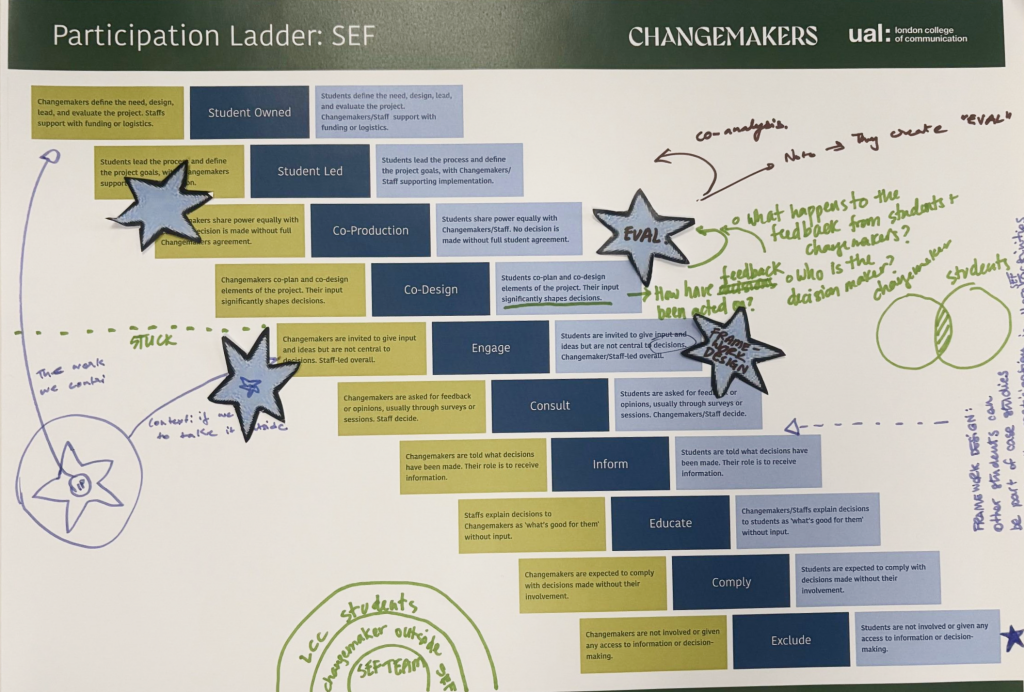
Activity 03: Participation Ladder

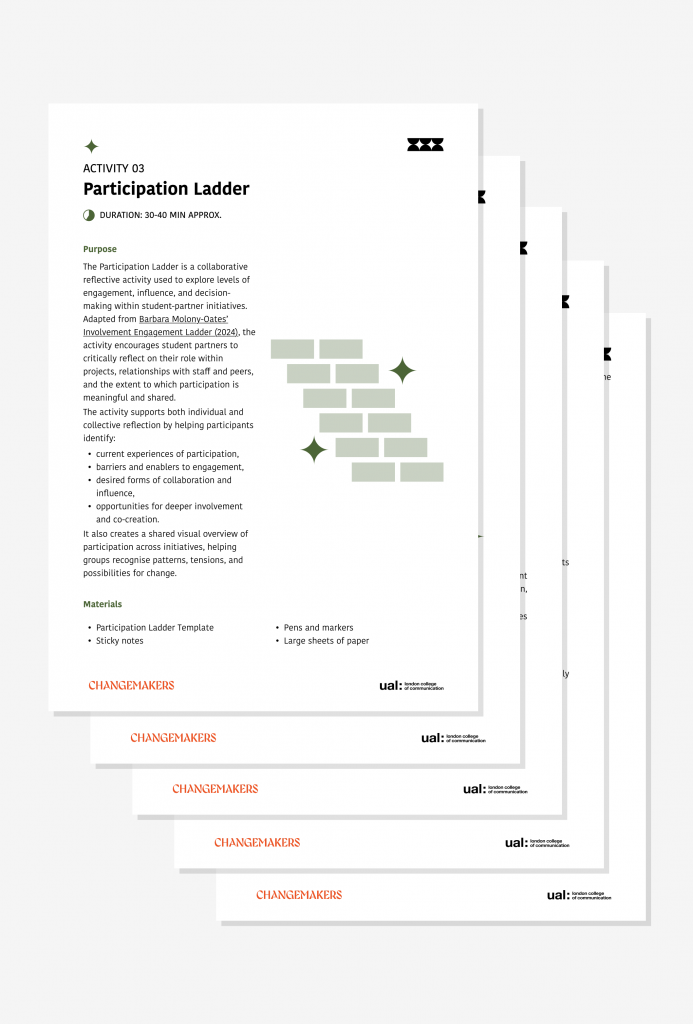
Activity 03
Participation Ladder

Duration: 45-60 min Approx.
Purpose
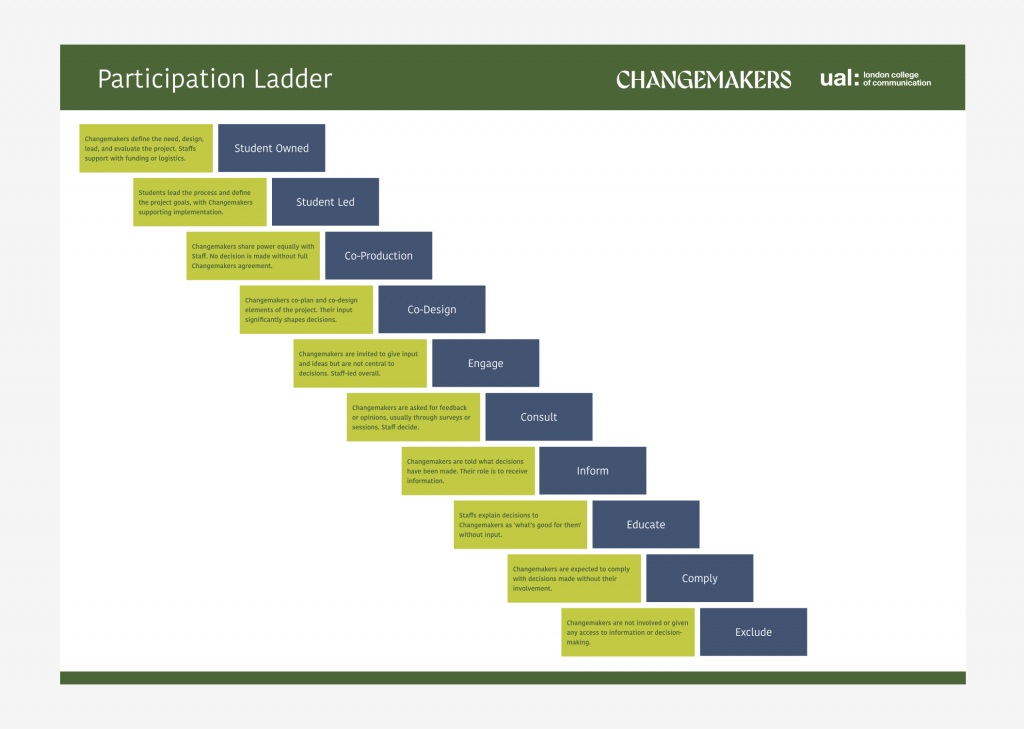
The Participation Ladder is a collaborative reflective activity used to explore levels of engagement, influence, and decision-making within student-partner initiatives. Adapted from Barbara Molony-Oates’ Involvement Engagement Ladder (2024), the activity encourages student partners to critically reflect on their role within projects, relationships with staff and peers, and the extent to which participation is meaningful and shared.
The activity supports both individual and collective reflection by helping participants identify:
- current experiences of participation,
- barriers and enablers to engagement,
- desired forms of collaboration and influence,
- opportunities for deeper involvement and co-creation.
It also creates a shared visual overview of participation across initiatives, helping groups recognise patterns, tensions, and possibilities for change.

Materials
- Participation Ladder Template
- Sticky notes
- Pens and markers
- Large sheets of paper
Instructions
Step 1: Introduce the Participation Ladder

Duration: 5-10 min
Introduce the Participation Ladder and briefly explain each level of participation represented within the framework.
Invite participants to reflect on:
- where they currently position themselves within their initiative(s),
- how much influence or decision-making power they experience,
- how collaborative or participatory the process feels.

Step 2: Position Yourself on the Ladder

Duration: 10-15 min
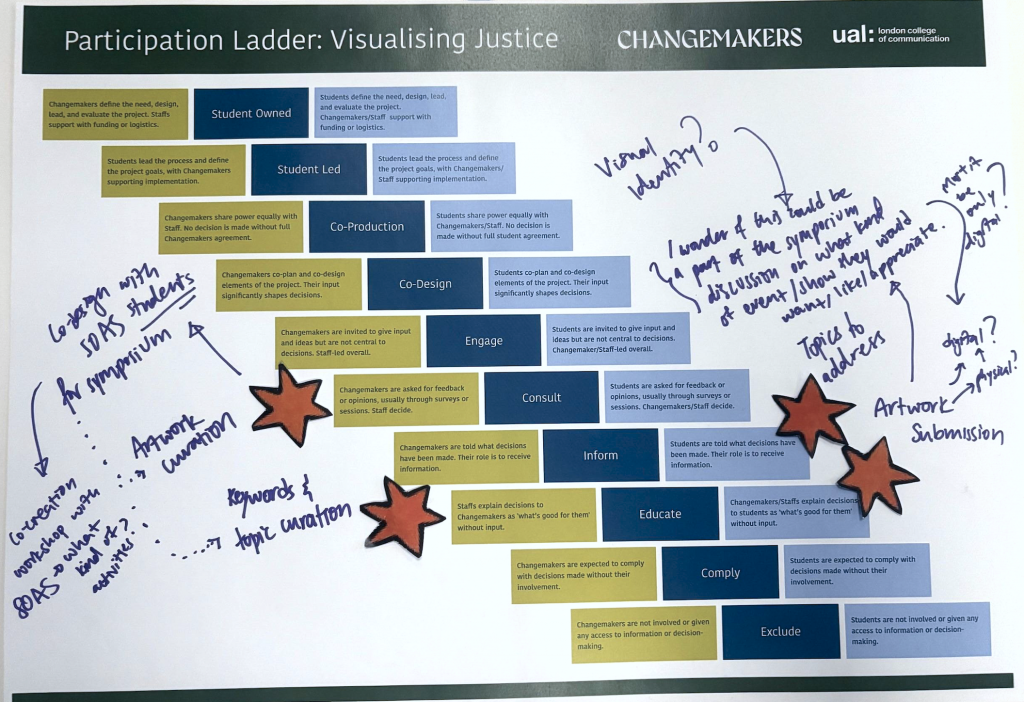
Invite participants to place themselves on the step that best represents their current level of involvement within the initiative or project.
Participants involved in multiple initiatives may complete more than one participation ladder. They might also work in teams.
Encourage participants to consider:
- decision-making power,
- communication and collaboration,
- opportunities for contribution,
- recognition and ownership,
- relationships with staff, peers, or communities.
Participants may annotate their ladders using words, symbols, or notes.

Step 3: Reflect on Movement and Change

Duration: 10-15 min
Invite participants to reflect individually or in pairs on:
- what has supported or limited their participation,
- where they would ideally like to be on the ladder,
- what changes might help deepen participation or collaboration,
- how participation has shifted over time.
Ask participants to identify at least one actionable step that could support movement towards their desired level of participation. This could include changes in communication, collaboration, decision-making, support structures, or opportunities for involvement.
Participants may write these actions directly onto their ladder template or on sticky notes for collective discussion.

Step 4: Group Discussion and Collective Reflection

Duration: 15-20 min Approx.
Facilitate a group conversation around shared experiences, tensions, patterns, and insights emerging from the activity.
Possible prompts:
- What patterns do you notice across different projects or experiences?
- What supports meaningful participation?
- What barriers or challenges emerge?
- How can collaboration and co-creation be strengthened moving forward?
Encourage participants to share only what feels comfortable.
Participants may write on the large sheets of paper the actionable steps collectively produced.
Outputs
This activity may generate:
- Visual or written scenarios,
- Storyboards or speculative narratives,
- Collective reflections on participation, collaboration, and institutional dynamics,
- Identification of recurring themes, tensions, and possibilities,
- Shared understanding developed through storytelling and collaborative interpretation.
With participants’ consent, facilitators may document recurring themes, anonymous scenarios, or photographs of storyboards to support collective evaluation, programme learning, and future recommendations.
Activity 04: Co-Analysis, Part 01: Scenario Building from Reflections
Activity 04
Co-Analysis, Part 01: Scenario Building from Reflections

Duration: 55-60 min Approx.
Purpose
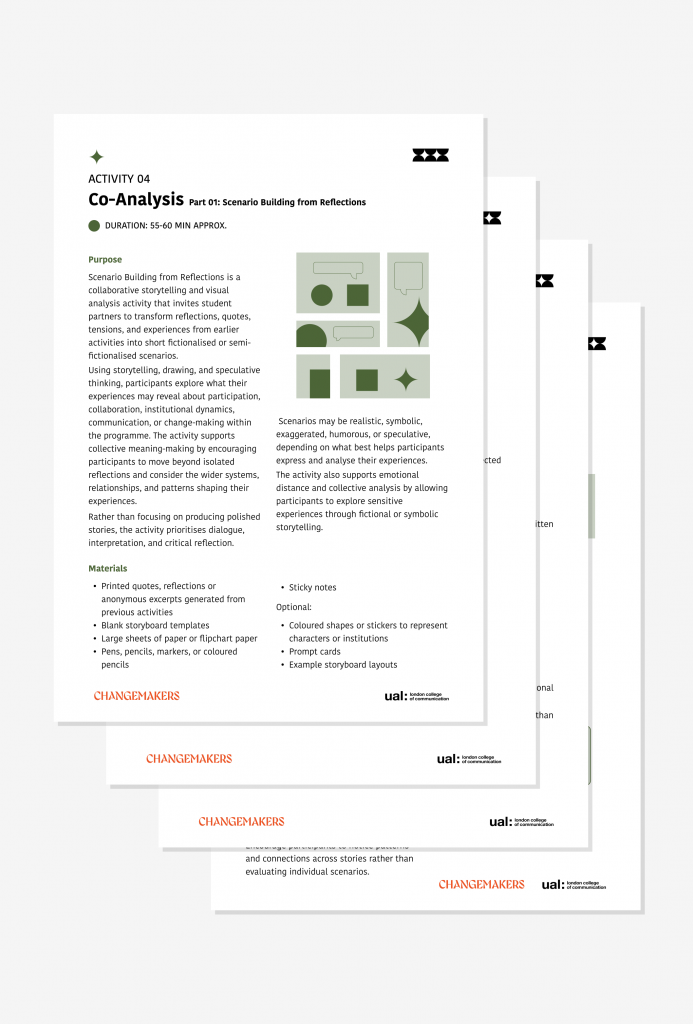
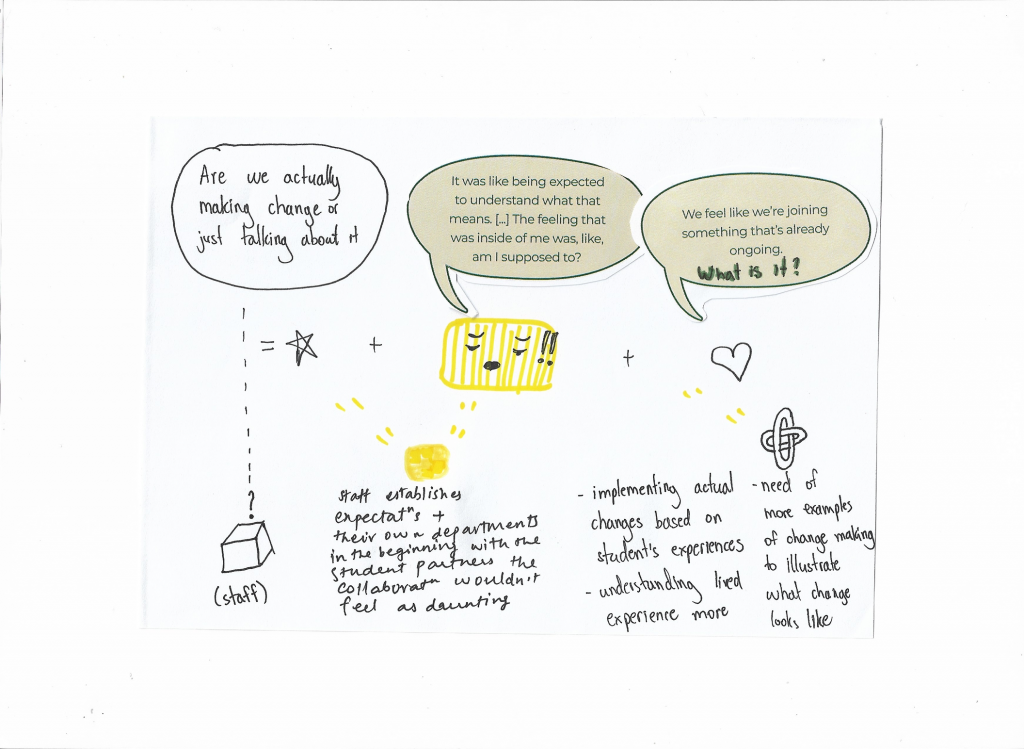
Scenario Building from Reflections is a collaborative storytelling and visual analysis activity that invites student partners to transform reflections, quotes, tensions, and experiences from earlier activities into short fictionalised or semi-fictionalised scenarios.
Using storytelling, drawing, and speculative thinking, participants explore what their experiences may reveal about participation, collaboration, institutional dynamics, communication, or change-making within the programme. The activity supports collective meaning-making by encouraging participants to move beyond isolated reflections and consider the wider systems, relationships, and patterns shaping their experiences.
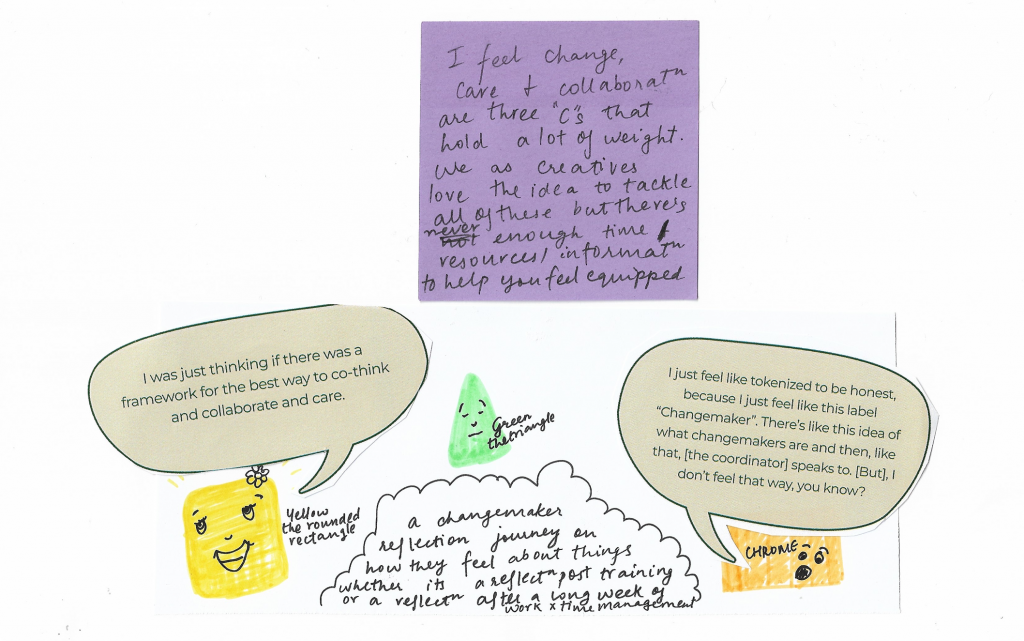
Rather than focusing on producing polished stories, the activity prioritises dialogue, interpretation, and critical reflection. Scenarios may be realistic, symbolic, exaggerated, humorous, or speculative, depending on what best helps participants express and analyse their experiences.
The activity also supports emotional distance and collective analysis by allowing participants to explore sensitive experiences through fictional or symbolic storytelling.

Materials
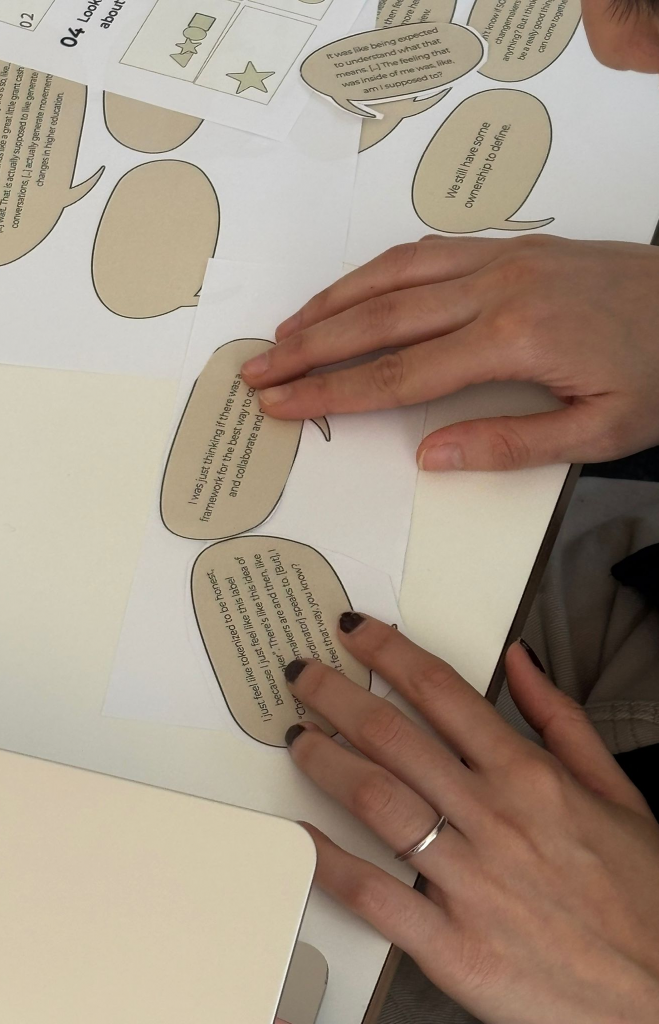
- Printed quotes, reflections or anonymous excerpts generated from previous activities
- Blank storyboard templates
- Large sheets of paper or flipchart paper
- Pens, pencils, markers, or coloured pencils
- Sticky notes
Optional:
- Coloured shapes or stickers to represent characters or institutions
- Prompt cards
- Example storyboard layouts
Instructions

Step 1: Read and Select Reflections

Duration: 10-15 min
Invite participants to review quotes, reflections, notes, or observations collected throughout previous activities.
Participants may work individually or in small groups to identify:
- reflections that feel emotionally significant,
- recurring tensions or challenges,
- moments of uncertainty, collaboration, or conflict,
- examples of meaningful participation or exclusion,
- questions or contradictions emerging across experiences.
Encourage participants to select one or several reflections that stand out to them.

Step 2: Create a Scenario or Storyboard

Duration: 20-30 min
Invite participants to transform their chosen reflection(s) into a short visual or written scenario.
Participants may:
- draw a storyboard,
- create a comic-strip sequence,
- use shapes or symbols to represent people or institutions,
- write short scenes or dialogue,
- create fictional or speculative future situations.
Scenarios should explore:
- what is happening,
- who is involved,
- what tensions, dynamics, or relationships are present,
- what the scenario may reveal about the programme, participation, or institutional structures.
Encourage participants to focus on communicating experiences and meanings rather than artistic skill.

Step 3: Reflect on the Scenario
Duration: 10-15 min
Invite participants to reflect on the scenarios they created.
Possible reflection prompts:
- What does this scenario reveal about the programme or experience?
- What tensions, assumptions, or dynamics are present?
- What emotions or perspectives emerge through the story?
- What barriers or opportunities does the scenario highlight?
- What does this scenario suggest about participation, communication, or collaboration?
Participants may annotate their storyboard or discuss reflections within small groups.
Step 4: Share and Discuss
Duration: 15-20 min
Invite participants to share their scenarios with the wider group if they feel comfortable doing so.
Facilitate discussion around:
- recurring themes across scenarios,
- differences in perspectives or experiences,
- common institutional or relational tensions,
- examples of care, collaboration, or resistance,
- insights emerging through storytelling and speculative thinking.
Encourage participants to notice patterns and connections across stories rather than evaluating individual scenarios.
Outputs
This activity may generate:
- Visual or written scenarios,
- Storyboards or speculative narratives,
- Collective reflections on participation, collaboration, and institutional dynamics,
- Identification of recurring themes, tensions, and possibilities,
- Shared understanding developed through storytelling and collaborative interpretation.
With participants’ consent, facilitators may document recurring themes, anonymous scenarios, or photographs of storyboards to support collective evaluation, programme learning, and future recommendations.
Activity 04: Co-Analysis, Part 02: Scenario Merging and Future Responses
Activity 04
Co-Analysis, Part 02: Scenario Merging and Future Responses
Duration: 60-75 min Approx.
Purpose
Scenario Merging and Future Responses is a collaborative co-analysis activity that invites student partners to collectively analyse, combine, and extend the scenarios developed in the previous activity.
Rather than treating scenarios as isolated stories, participants identify recurring themes, shared tensions, and overlapping experiences across multiple scenarios. Through discussion and collaborative synthesis, participants merge ideas together to create new collective narratives that reflect broader patterns, institutional dynamics, and shared concerns.
The activity then introduces speculative and future-oriented thinking by inviting participants to imagine possible responses, interventions, or changes that could address the tensions emerging from the merged scenarios.
Participants introduce fictional or symbolic “expert characters” to help explore how change, collaboration, or resolution might occur.
The activity supports collaborative analysis, systems thinking, and collective imagination by encouraging participants to move from reflection toward possibility, action, and future-oriented recommendations.

Materials
- Scenarios or storyboards created during Activity 04 Part 01
- Deepa Iyer’s Social Change Ecosystem Map
- Printed Expert Card Template
- Blank storyboard templates
- Large sheets of paper
- Sticky notes
- Pens, pencils, markers, or coloured pencils
Instructions
Step 1: Share and Compare Scenarios
Duration: 10-15 min
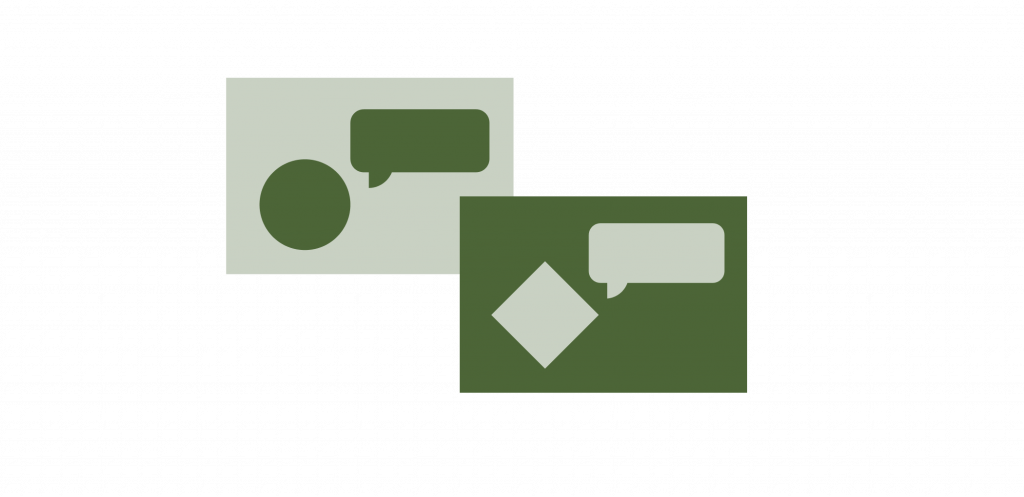
Invite participants to present or display the scenarios created during Activity 04 Part 01.
In groups, encourage participants to identify:
- recurring themes,
- shared tensions or barriers,
- similarities or differences across experiences,
- patterns connected to participation, communication, power, or collaboration,
- moments of possibility, care, or transformation.
Participants may annotate scenarios with sticky notes or keywords.
Step 2: Merge Scenarios into a Collective Narrative
Duration: 20-25 min
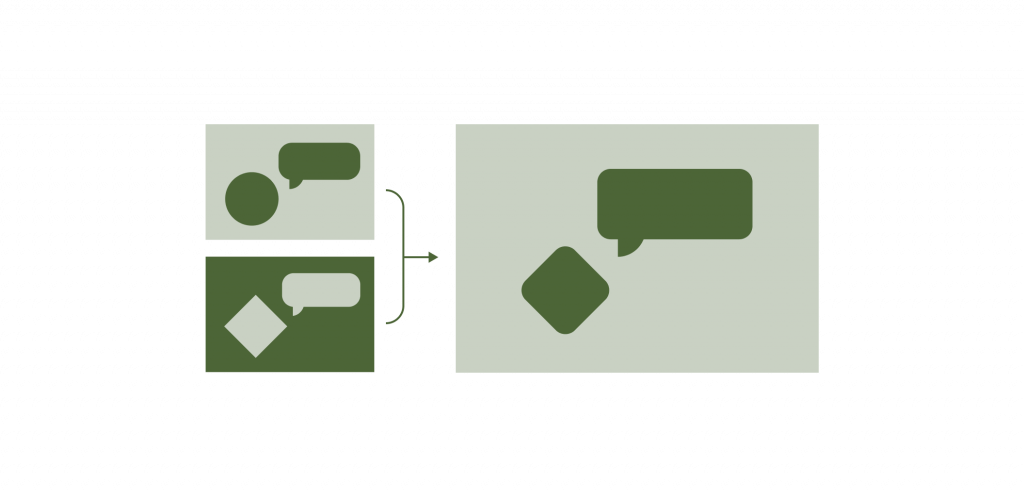
Invite participants to work in small groups to merge two or more scenarios into a new shared scenario.
Encourage participants to:
- identify the deeper themes connecting the stories,
- create a new scenario rather than simply combining events,
- focus on what the merged scenario reveals collectively,
- explore broader institutional or relational dynamics,
- represent multiple perspectives where possible.
Participants may use drawings, dialogue, symbols, maps, or written descriptions to develop the merged scenario.
Snowball option: depending on group size, Step 2 can be repeated by merging scenarios until the creation of one, two or the desired number of final collective scenarios.
Step 3: Create Expert Characters
Duration: 10-15 min
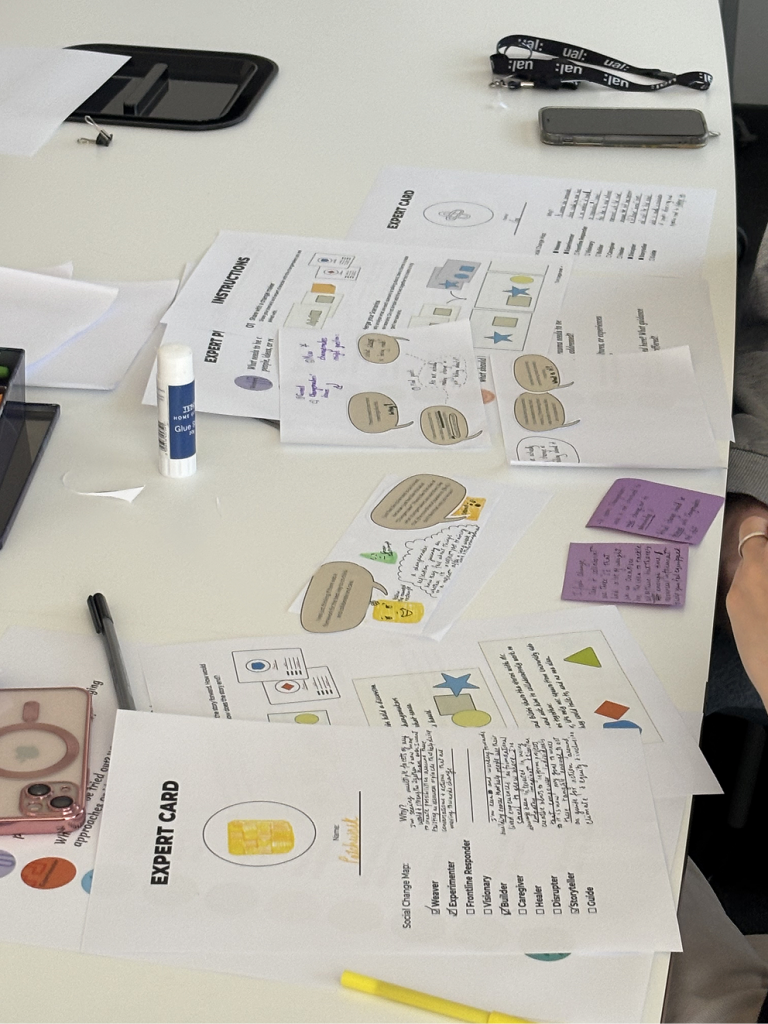
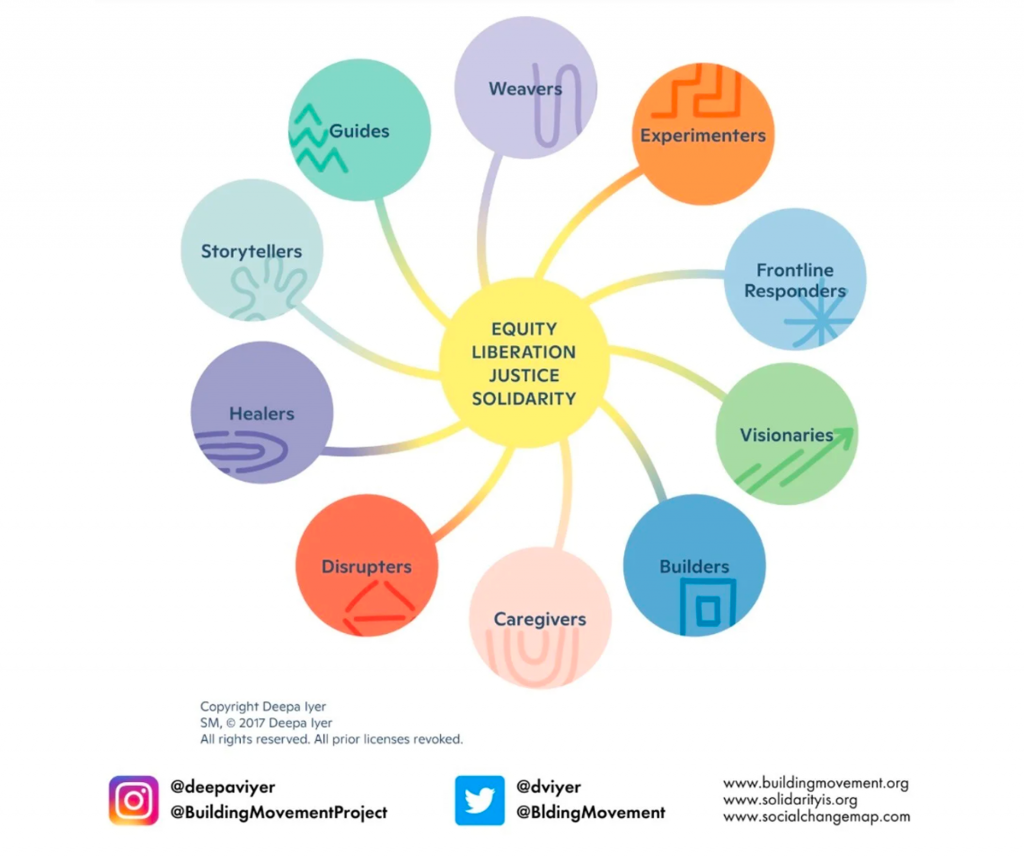
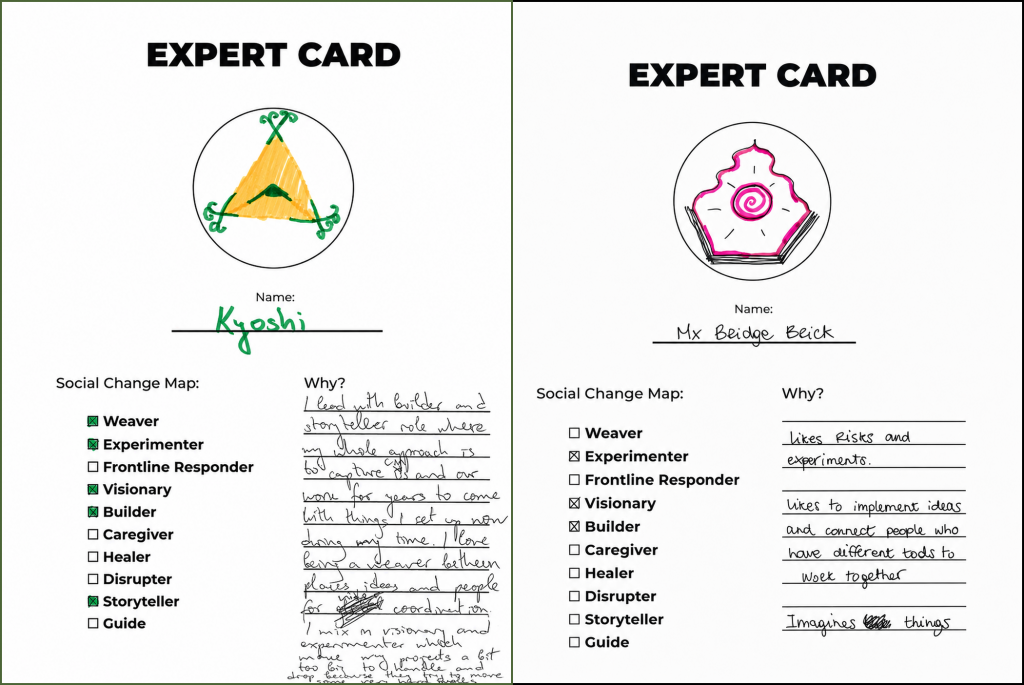
At this stage, participants create an “expert character” using Deepa Iyer’s Social Change Ecosystem Map, developed with the Building Movement Project, and the Expert Card template.
Expert characters are not random fictional additions. Each participant selects one or more social change roles that reflect how they approach collaboration, care, change-making, or collective action.
Participants may identify with roles such as:
- Weavers, Healers, Storytellers, Builders, Guides, Visionaries, Experimenters, Frontline Responders, Caregivers, or Disrupters.
Using the Expert Card template, participants are invited to:
- name their expert character,
- identify their selected social change role(s),
- reflect on why they connect with those roles,
- consider the strengths, values, or perspectives their character brings into collective situations.

Step 4: Create Futures Responses

Duration: 10-15 min
Participants introduce these expert characters into the merged scenario to explore how different approaches to social change, collaboration, care, or leadership may shape future responses.
Ask participants to explore:
- how these expert characters would respond,
- what actions or conversations might happen next,
- what changes or interventions could improve the situation,
- what forms of collaboration, care, or accountability may emerge,
- whether tensions are resolved, transformed, or remain ongoing.
Encourage participants to think creatively and critically about possible futures.

Step 5: Collective Reflection and Discussion

Duration: 15-20 min
Facilitate a group discussion reflecting on the merged scenarios and future responses.
Possible reflection prompts:
- What broader themes or patterns emerged through the merging process?
- What do these scenarios reveal about participation, institutional structures, or collaboration?
- What kinds of support, communication, or change seem necessary?
- What possibilities for action or transformation emerged?
- What recommendations or insights could inform future programmes or partnerships?
Encourage participants to reflect on both tensions and possibilities generated through the activity.

Outputs
This activity may generate:
- Merged collaborative scenarios,
- Speculative or future-oriented narratives,
- Collective reflections on systems, participation, and institutional dynamics,
- Recommendations, action points, or ideas for programme development,
- Shared understanding generated through collaborative interpretation and future-thinking.
With participants’ consent, facilitators may document recurring themes, collective recommendations, anonymous scenarios, or photographs of the outputs to support programme evaluation, future programme design, and collective learning.
These scenarios may also contribute to future discussions, reports, presentations, or advocacy work connected to student partnership and participatory evaluation practices.

Debrief
The Debriefing stage marks the closing phase of the student partners’ journey within the programme. It provides a dedicated space for reflection, celebration, dialogue, and evaluation following the completion of projects and activities.
This stage encourages student partners to revisit their experiences, reflect on personal and collective growth, and consider how their understanding of participation, collaboration, and social justice work may have evolved throughout the programme. It also creates opportunities to acknowledge achievements, share feedback, and collectively make meaning of the journey.
The Debriefing process supports both reflective learning and programme evaluation by capturing experiences, insights, challenges, and recommendations that may inform future iterations of the programme.
05
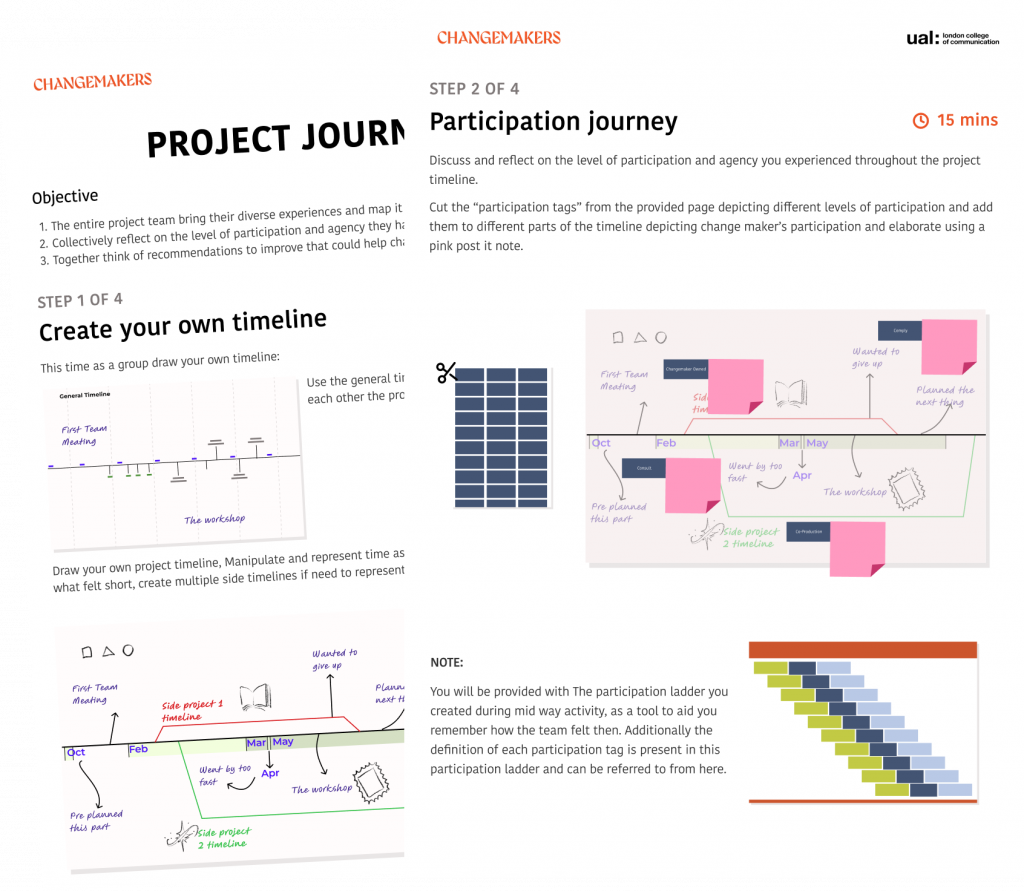
Embodied Journey Mapping
06
Participation Journey Mapping
07
Flower-Making Ritual
Activity 05: Embodied Journey Mapping

Activity 05
Embodied Journey Mapping

Duration: 50-65 min Approx.
Purpose
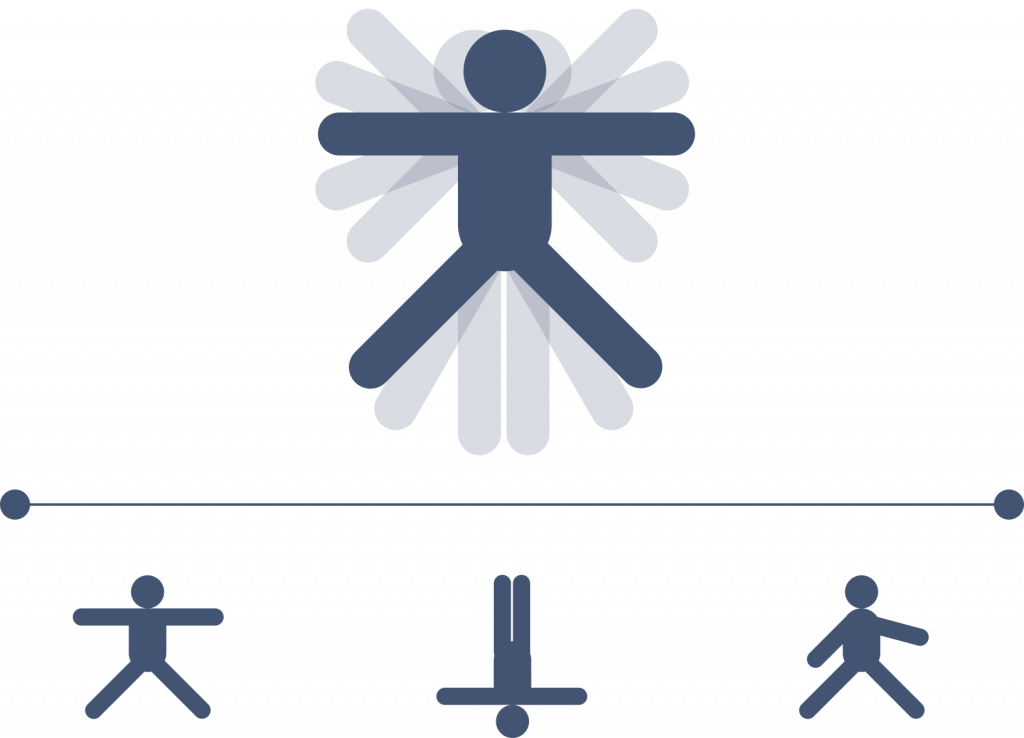
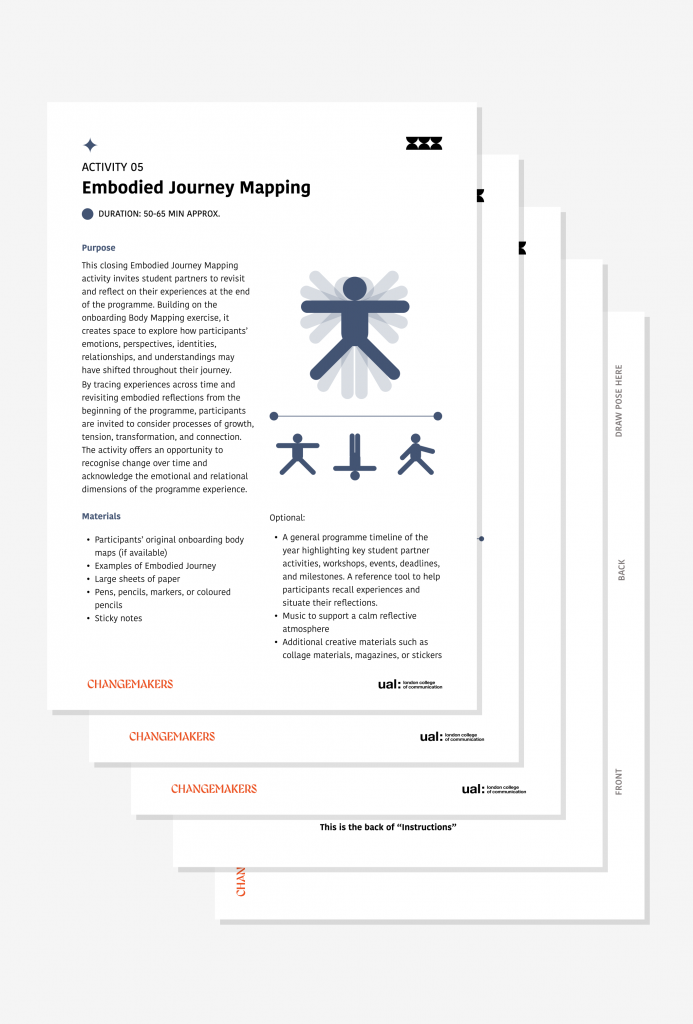
This closing Embodied Journey Mapping activity invites student partners to revisit and reflect on their experiences at the end of the programme. Building on the onboarding Body Mapping exercise, it creates space to explore how participants’ emotions, perspectives, identities, relationships, and understandings may have shifted throughout their journey.
By tracing experiences across time and revisiting embodied reflections from the beginning of the programme, participants are invited to consider processes of growth, tension, transformation, and connection. The activity offers an opportunity to recognise change over time and acknowledge the emotional and relational dimensions of the programme experience.
Materials
- Participants’ original onboarding body maps (if available)
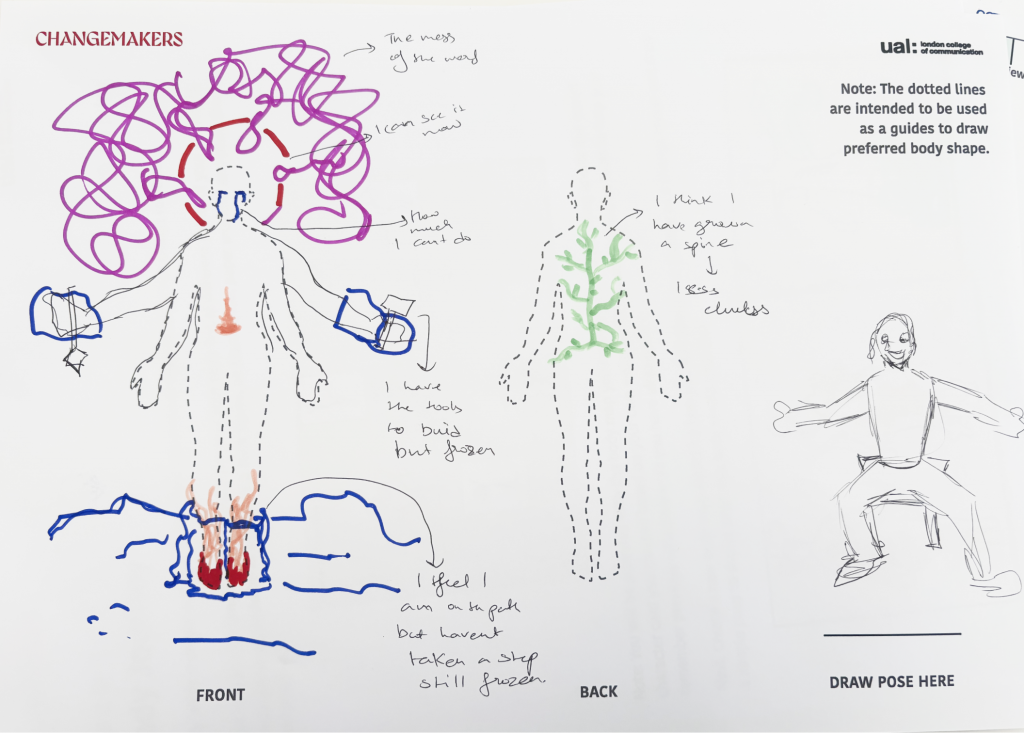
- Examples of Embodied Journey
- Large sheets of paper
- Pens, pencils, markers, or coloured pencils
- Sticky notes
Optional:
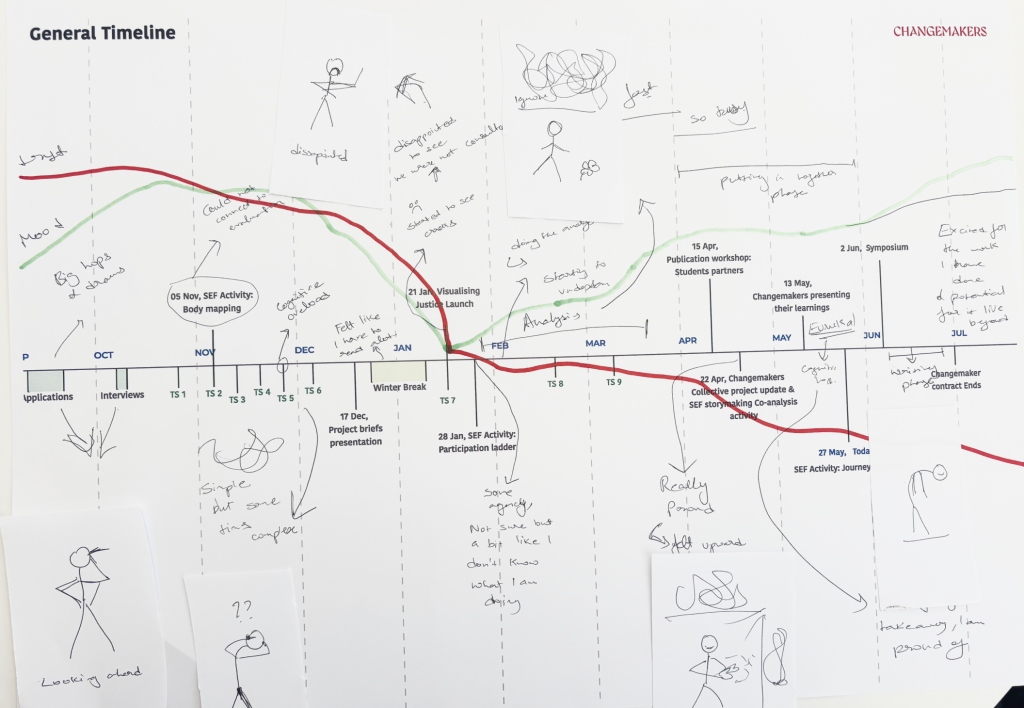
- A general programme timeline of the year highlighting key student partner activities, workshops, events, deadlines, and milestones. A reference tool to help participants recall experiences and situate their reflections.
- Music to support a calm reflective atmosphere
- Additional creative materials such as collage materials, magazines, or stickers
Instructions

Step 1: Reflection on Onboarding Body Maps

Duration: 5 min
Invite participants to revisit their onboarding body map and reflect on whether their experiences, emotions, relationships, or perspectives have shifted throughout the programme.
Participants may spend a few quiet moments observing their original body map before beginning the next stage.

Step 2: Create an Embodied Journey Timeline

Duration: 15-20 min
Using colours, words, drawings, symbols, timelines, or collage materials, invite participants to create a visual timeline tracing their experiences throughout the programme.
The journey may represent:
- moments of challenge, growth, or achievement,
- emotional highs and lows,
- relationships, connections, or communities formed,
- changes in confidence, participation, or understanding,
- significant moments, tensions, or turning points,
- how participants now relate to their work, learning, or participation.
Participants may work quietly and independently during this stage.

Step 3: Create a Present Body Map

Duration: 15-20 min
Using colours, words, drawings, symbols, or collage materials, invite participants to create a new body map informed by the journey they have just reflected on.
This body map should represent participants’ present experiences, perspectives, emotions, identities, and relationships at the end of the programme.
Participants may choose to:
- build directly onto their onboarding body map,
- or create a second body map from scratch for comparison.

Step 4: Reflection and Sharing

Duration: 15-20 min
Invite participants to reflect individually or share aspects of their body journeys with the group. Sharing should remain voluntary.
Possible reflection prompts:
- What changes do you notice compared to the beginning of the programme?
- What experiences or relationships had the greatest impact on you?
- What strengths or learning are you leaving the programme with?
- What emotions or reflections remain most present for you now?
Facilitators may close the activity with a grounding exercise or collective check-out.
Outputs
This activity may generate:
- Individual reflective body journeys and body maps,
- Visual representations of growth, emotions, and learning,
- Comparative reflections between onboarding and debriefing experiences,
- Shared insights into personal and collective transformation,
- Greater recognition of emotional, relational, and social dimensions of the programme experience.
With participants’ consent, facilitators may document recurring themes, anonymous reflections, or photographs of the body journeys and body maps to support collective evaluation and programme learning.
Activity 06: Participation Journey Mapping
Activity 06
Participation Journey Mapping
Duration: 60-80 min Approx.
Purpose
This closing Participation Journey Mapping activity invites student partners to revisit and critically reflect on their experiences of participation, collaboration, influence, and engagement throughout the programme.
Building on the Participation Ladder activity introduced during the Midway Check-in, the activity creates space for participants to reflect on how their sense of participation, agency, relationships, and involvement may have shifted over time.
By tracing participation experiences across the programme journey, participants are encouraged to explore moments of empowerment, uncertainty, collaboration, tension, growth, or exclusion, while considering the relational and institutional dynamics that shaped these experiences.
The activity also supports reflective learning and collective evaluation by helping participants recognise patterns, turning points, and evolving understandings of participation and partnership work.By tracing experiences across time and revisiting embodied reflections from the beginning of the programme, participants are invited to consider processes of growth, tension, transformation, and connection. The activity offers an opportunity to recognise change over time and acknowledge the emotional and relational dimensions of the programme experience.

Materials
- Participants’ previous Participation Ladder reflections (if available)
- Examples of Participation Journey
- Printed Participation Ladder templates
- Printed Participation Tags
- Printed recommendations from Co-Analysis Session
- Large sheets of paper
- Pens, pencils, markers, or coloured pencils
- Sticky notes
Optional:
- A general programme timeline of the year highlighting key student partner activities, workshops, events, deadlines, and milestones. A reference tool to help participants recall experiences and situate their reflections.
Instructions
Step 1: Reflection on Previous Participation Ladders
Duration: 5 min
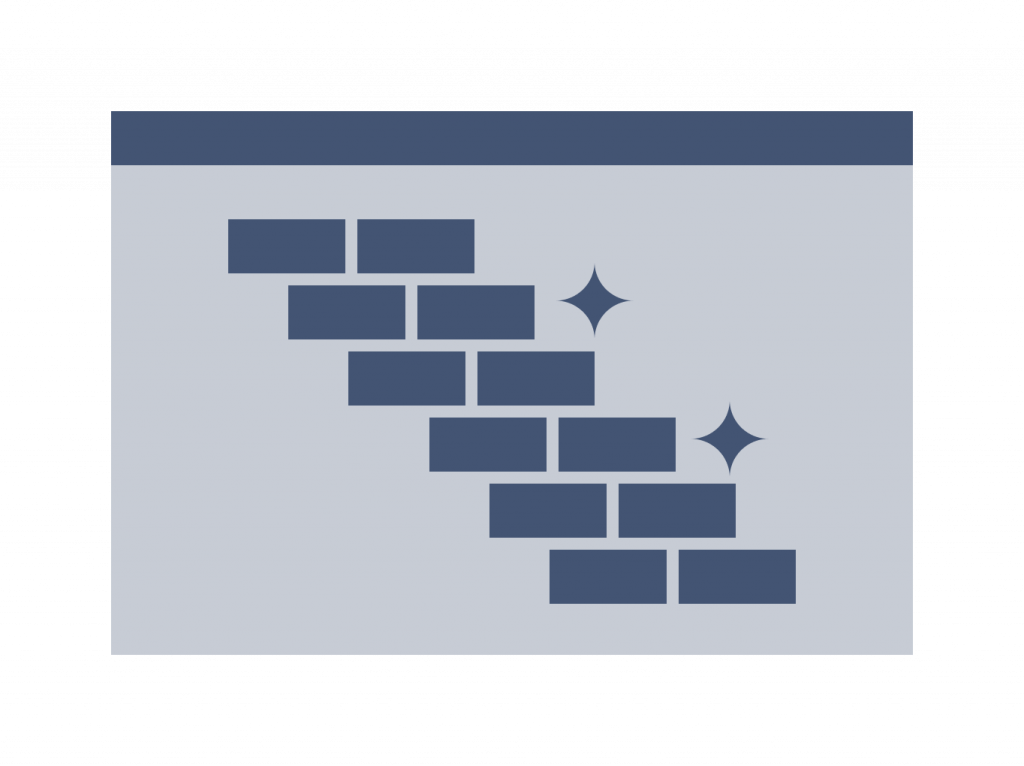
Invite participants to revisit their Participation Ladder reflections from the Midway Check-in and reflect on whether their experiences of participation, collaboration, communication, or influence have changed throughout the programme.
Participants involved in multiple initiatives may revisit more than one previous Participation Ladder. Where participants worked on a shared initiative, they may choose to reflect individually or as a team.
Participants may spend a few quiet moments observing their previous reflections before beginning the next stage.

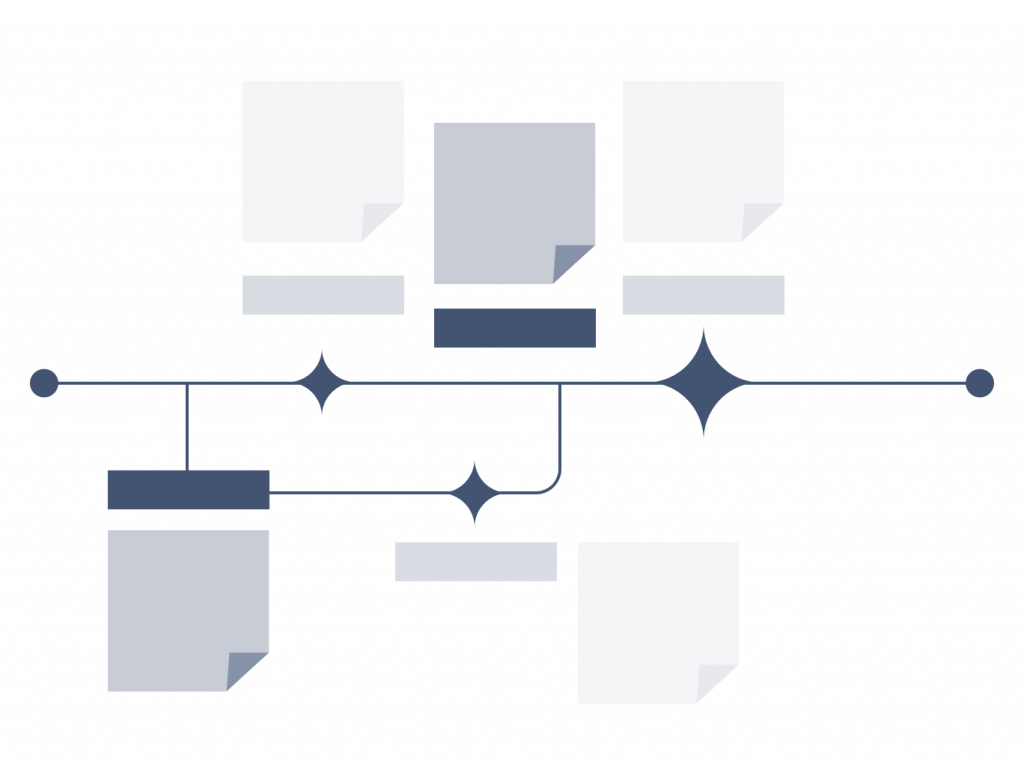
Step 2: Create a Participation Journey
Duration: 15-20 min
Using colours, words, drawings, symbols, timelines, or collage materials, invite participants to create a visual “journey” tracing their experiences of participation throughout the programme.
The journey may represent:
- moments where participation felt meaningful or limited,
- shifts in confidence, agency, or influence,
- experiences of collaboration or co-creation,
- barriers or tensions encountered,
- relationships with peers, staff, or communities,
- moments of recognition, uncertainty, or growth,
- changes in communication, ownership, or decision-making.
Participants may work individually or in teams, depending on whether they are reflecting on a personal journey or a shared project experience.
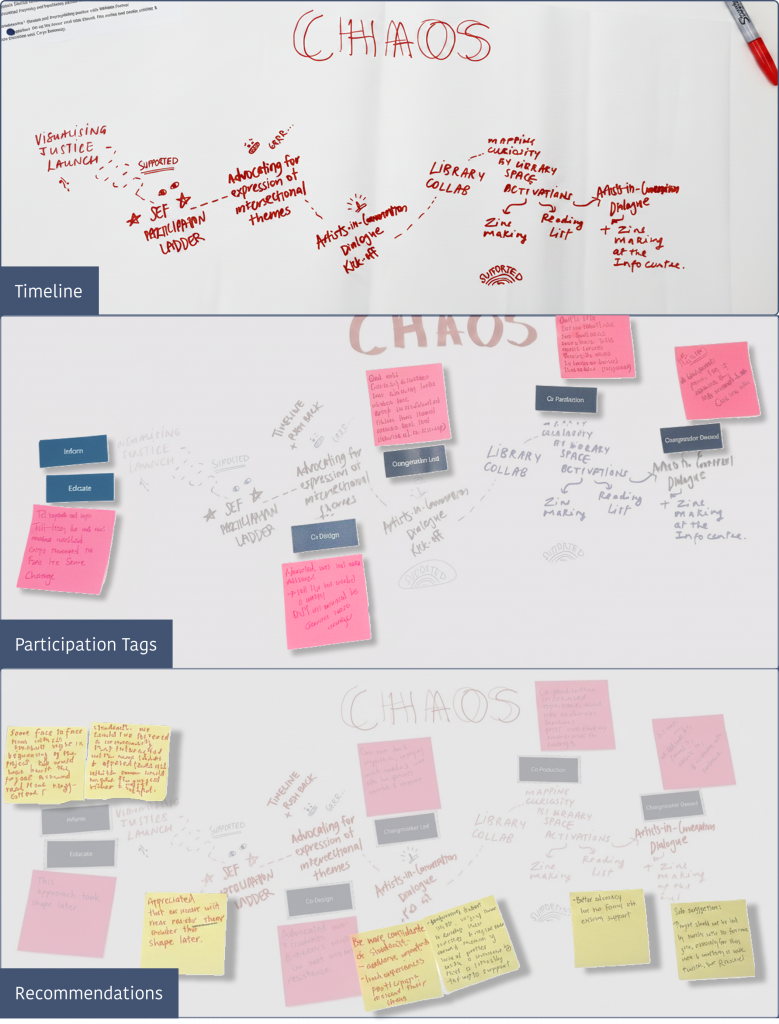
Step 3: Add Participation Tags
Duration: 15-20 min
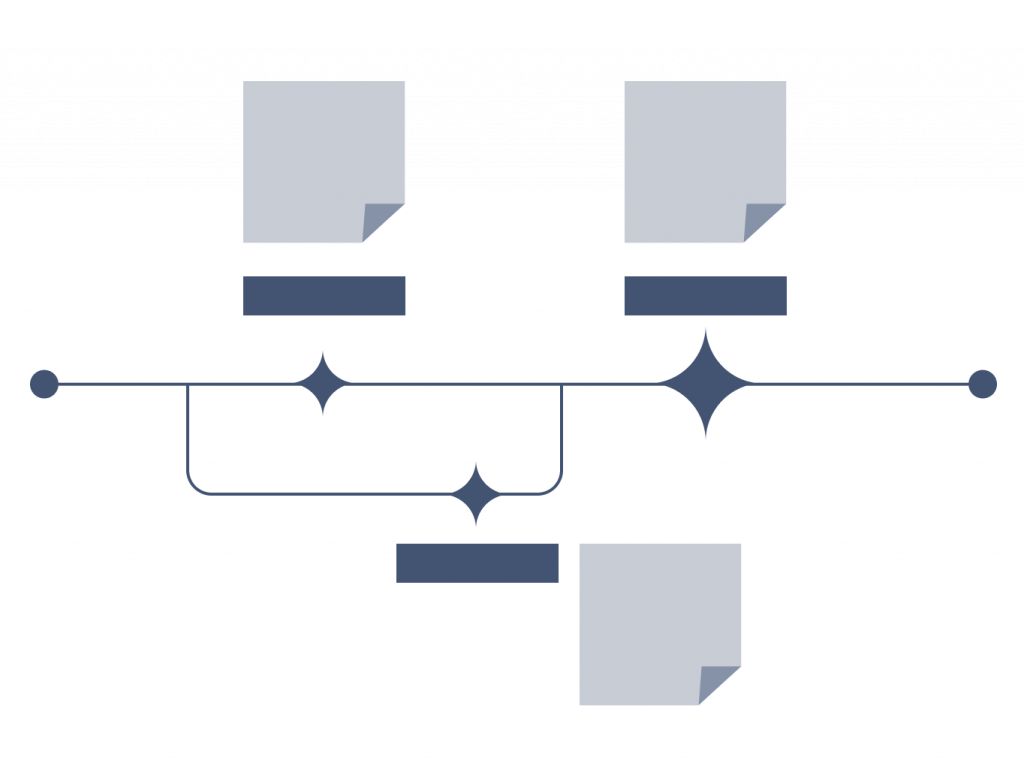
Invite participants to review the participation tags and select those that best represent their perceived levels of engagement at different points in the journey.
Participants should place the tags directly onto their timeline or visual journey to show how participation, influence, collaboration, or decision-making shifted over time.
Encourage participants to reflect on:
- where they felt most involved or influential,
- where participation felt limited or unclear,
- where engagement was affected by external factors,
- where their sense of agency changed,
- what moments shaped their position on the Participation Ladder.
Step 4: Create a New Participation Ladder
Duration: 15-20 min
Invite participants to complete a new Participation Ladder that represents where they feel they are now, at the end of the programme.
Participants should position themselves on the ladder according to their current understanding of their participation, collaboration, influence, and engagement.
Encourage participants to reflect on:
- where they feel positioned now and why,
- how their current level of participation compares to earlier moments in the programme.
Step 5: Integrate Recommendations

Duration: 10 min
Invite participants to review printed recommendations generated during the Co-Analysis stage and place them near the participation tags or moments in the journey where they feel the recommendation, support, or change would have been most relevant.
This helps connect collective recommendations to specific moments in the programme journey, showing where different forms of support, communication, collaboration, or institutional change may have influenced participation.
Encourage participants to reflect on:
- what recommendations feel most significant to their journey,
- where support or intervention could have improved participation,
- how institutional or relational changes may have altered moments of challenge, exclusion, uncertainty, or growth,
- how collective reflections connect to individual or team experiences.

Step 6: Reflection and Sharing
Duration: 15-20 min
Invite participants to reflect individually or share aspects of their participation journeys and ladder reflections with the group. Sharing should remain voluntary.
Possible reflection prompts:
- What changes do you notice compared to the Midway Check-in?
- What moments most shaped your sense of participation?
- What supported meaningful collaboration or engagement?
- What barriers or tensions remained present?
- What have you learned about participation, partnership, or collective work through this experience?
Facilitators may close the activity with a grounding exercise or collective check-out.
Outputs
This activity may generate:
- Individual or team-based participation journeys,
- Participation tags positioned across the journey to indicate perceived levels of engagement, influence, collaboration, and decision-making over time,
- A new Participation Ladder reflection representing participants’ current position at the end of the programme,
- Visual representations of participation, collaboration, and growth over time,
- Comparative reflections between Midway Check-in and Debriefing experiences,
- Shared insights into participation, agency, relationships, and institutional dynamics,
- Recommendations positioned across the journey to show where specific forms of support, communication, collaboration, or institutional change may have helped,
- Reflections and recommendations for strengthening future partnership practices.
With participants’ consent, facilitators may document recurring themes, anonymous reflections, or photographs of the participation journeys, participation tags, and Participation Ladder reflections to support collective evaluation and programme learning.
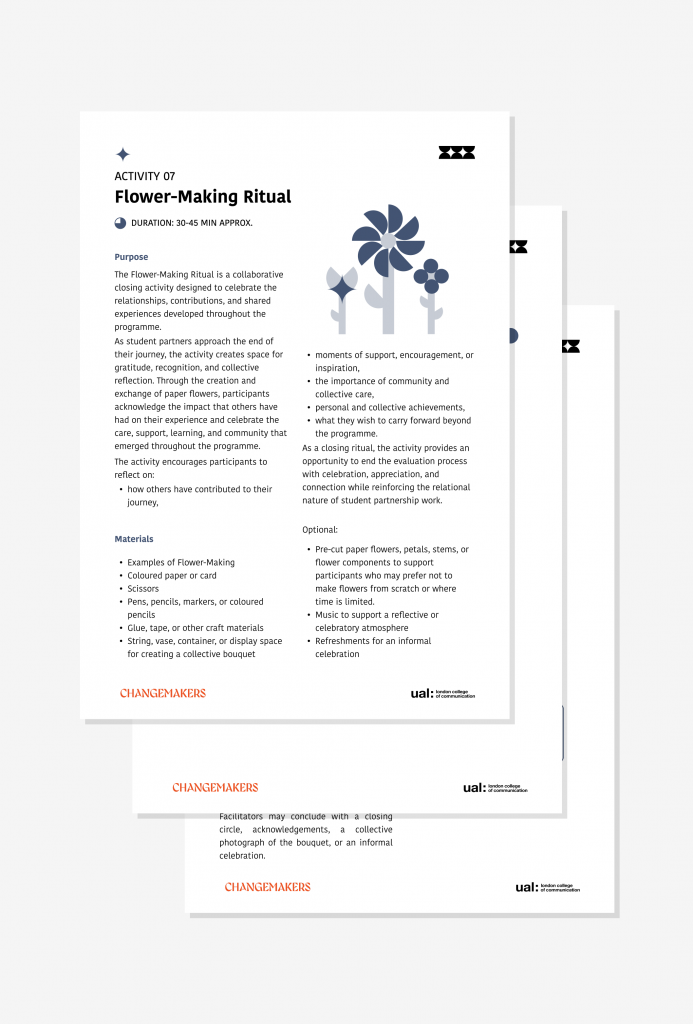
Activity 07: Flower-Making Ritual
Activity 07
Flower-Making Ritual

Duration: 30-45 min Approx.
Purpose
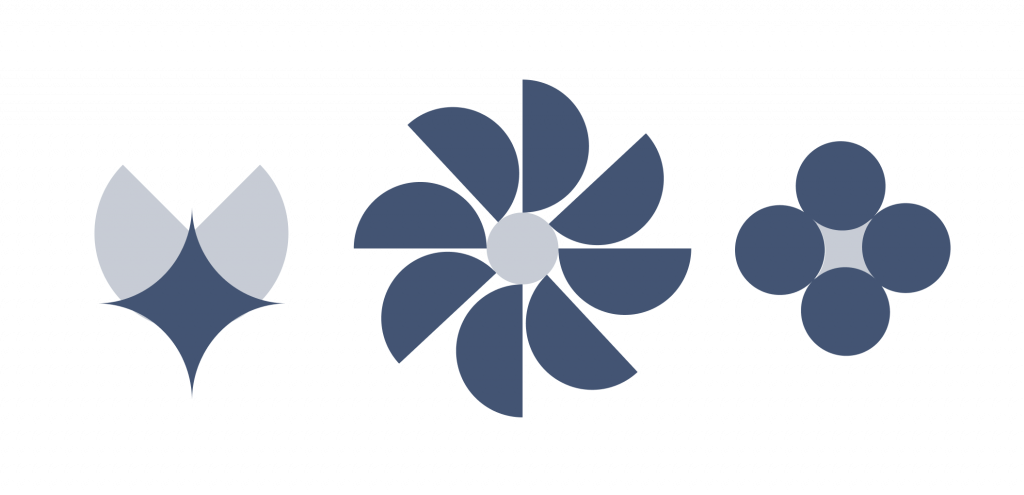
The Flower-Making Ritual is a collaborative closing activity designed to celebrate the relationships, contributions, and shared experiences developed throughout the programme.
As student partners approach the end of their journey, the activity creates space for gratitude, recognition, and collective reflection. Through the creation and exchange of paper flowers, participants acknowledge the impact that others have had on their experience and celebrate the care, support, learning, and community that emerged throughout the programme.
The activity encourages participants to reflect on:
- how others have contributed to their journey,
- moments of support, encouragement, or inspiration,
- the importance of community and collective care,
- personal and collective achievements,
- what they wish to carry forward beyond the programme.
As a closing ritual, the activity provides an opportunity to end the evaluation process with celebration, appreciation, and connection while reinforcing the relational nature of student partnership work.

Materials
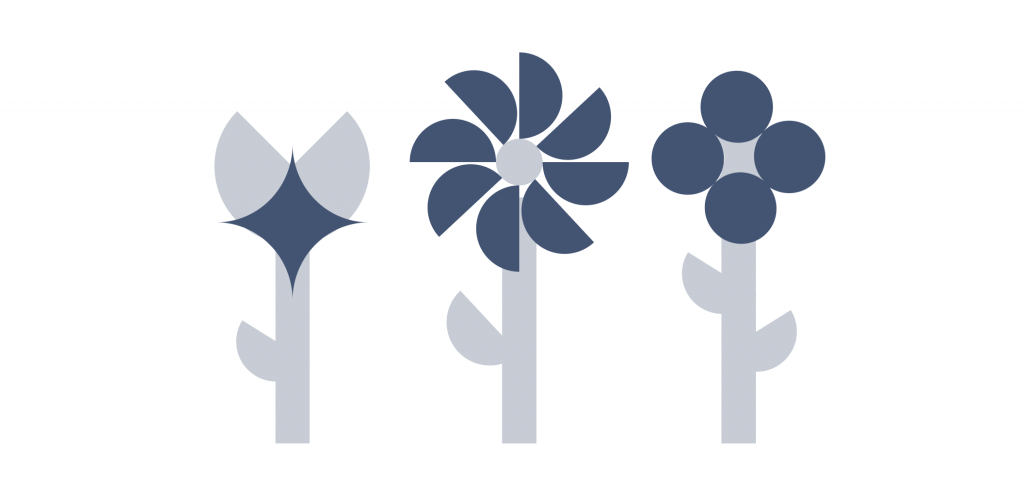
- Examples of Flower-Making
- Coloured paper or card
- Scissors
- Pens, pencils, markers, or coloured pencils
- Glue, tape, or other craft materials
- String, vase, container, or display space for creating a collective bouquet
Optional:
- Pre-cut paper flowers, petals, stems, or flower components to support participants who may prefer not to make flowers from scratch or where time is limited.
- Music to support a reflective or celebratory atmosphere
- Refreshments for an informal celebration
Instructions
Step 1: Create Individual Flowers

Duration: 10-15 min
Invite participants to create one paper flower for each other student partner in the group.
Participants may decorate each flower using colours, drawings, symbols, or designs that feel meaningful or appropriate.

Step 2: Write Appreciation Messages

Duration: 10-15 min
On the back of each flower, invite participants to write a short message of appreciation, recognition, or encouragement for the person who will receive it.
Messages may acknowledge:
- contributions to the group,
- acts of support or care,
- memorable moments,
- personal strengths,
- growth observed throughout the programme,
- hopes for the future.
Encourage participants to be specific, thoughtful, and authentic.
Step 3: Exchange Flowers and Create a Collective Bouquet

Duration: 10-15 min
Invite participants to exchange flowers with one another and take time to read the messages they have received.
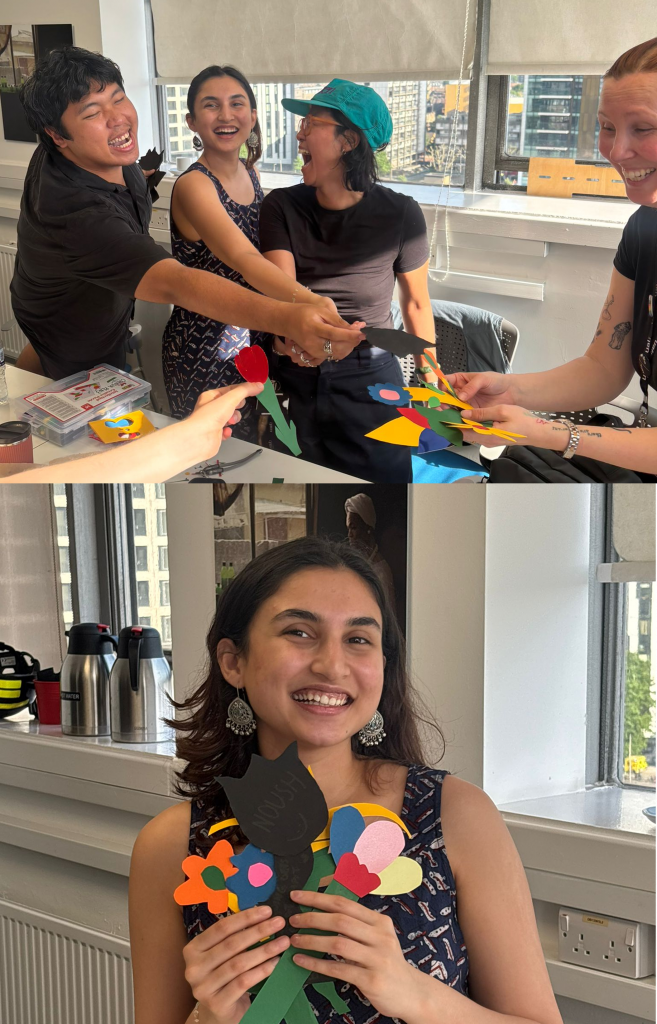
As flowers are exchanged, gather them together to create a collective bouquet representing the relationships, experiences, and community developed throughout the programme.
Facilitators may invite participants to share reflections, read selected messages aloud, or simply spend time observing the collective bouquet.

Step 4: Closing Reflection
Duration: 5-10 min
Invite participants to reflect on the experience individually or as a group.
Possible reflection prompts:
- What did you appreciate most about this experience?
- What surprised you while creating or receiving flowers?
- What relationships or moments stand out when you look back on the programme?
- What are you taking forward from this journey?
Facilitators may conclude with a closing circle, acknowledgements, a collective photograph of the bouquet, or an informal celebration.
Outputs
This activity may generate:
- Individual paper flowers with appreciation messages,
- A collective bouquet representing the programme community,
- Reflections on care, support, and collaboration,
- Shared recognition of contributions and achievements,
- Opportunities for celebration, closure, and collective appreciation.
With participants’ consent, facilitators may document photographs of the collective bouquet or anonymous reflections emerging from the activity to support programme reflection and collective learning.


One-to-One Supervision
The One-to-One Supervision activities are designed to support meaningful reflection, wellbeing, and structured documentation throughout the student partners’ journey. They provide a dedicated space for supervisors and student partners to reflect on experiences, discuss progress and challenges, and support personal and professional development across the programme.
The supervision process is also intended to function as a confidential reflective space where student partners may discuss experiences, challenges, tensions, wellbeing, or support needs that they may not feel comfortable sharing within collective group activities. Supervisors may use these conversations to identify patterns, provide support, and consider responsive actions or adjustments throughout the programme.
The supervision process also contributes to the broader evaluation framework by supporting reflective learning, identifying emerging needs and learning outcomes, and informing ongoing programme development and responsive support practices.
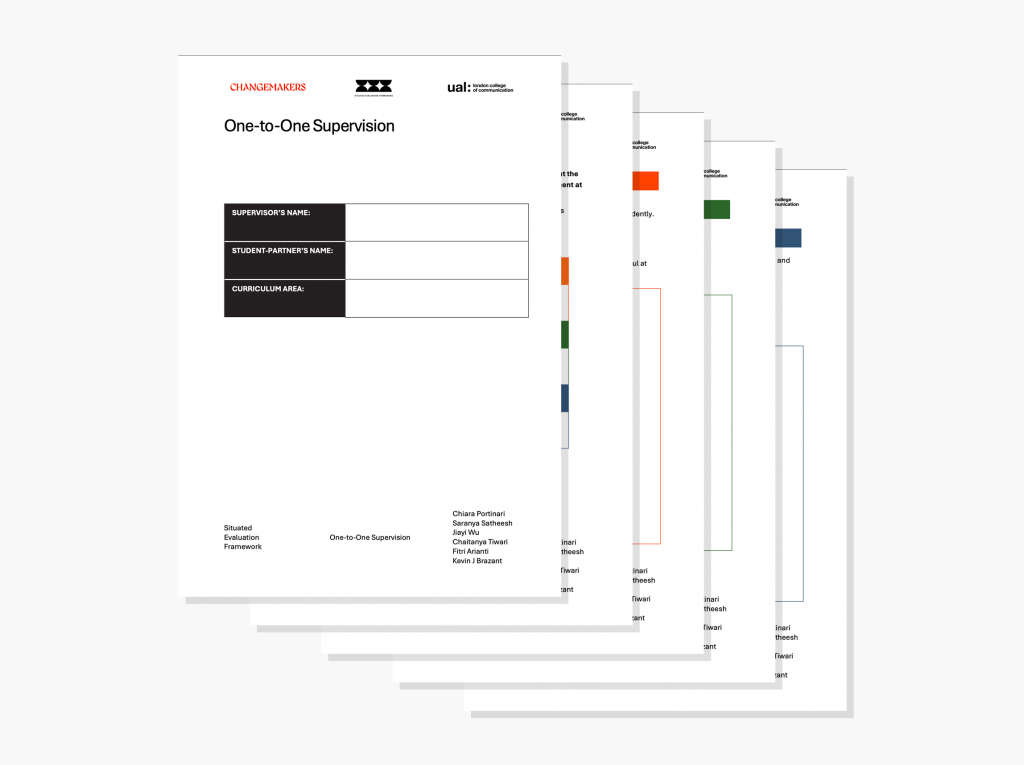
The One-to-One Supervision Template is a document designed to guide reflective conversations between supervisors and student partners throughout the programme.
Similarly to the In-Person Activities, the One-to-One Supervision includes three reflective touchpoints:

Onboarding
Early reflections on joining the programme, including expectations, initial feelings, and any training or support needs.

Midway Check-in
A check-in on how things are progressing, what’s going well or needs support, and whether a case study is being developed.

Debrief
Final reflections on the experience, feedback on the programme, and thoughts on how it connects to future goals.
Instructions
The supervision template is intended to guide conversation rather than function as a fixed script. Supervisors are encouraged to adapt prompts and discussions according to the needs, experiences, and comfort of each student partner.
During supervision sessions, supervisors should aim to:
- Create a supportive, respectful, and non-judgemental environment,
- Encourage honest reflection and open dialogue,
- Listen actively to both achievements and challenges,
- Support student partners in recognising their growth and contributions,
- Document key reflections collaboratively where appropriate, and
- Identify any additional support, resources, or opportunities that may be helpful.
The notes gathered through these conversations may support reflective learning, programme evaluation, and future programme development. Documentation should be handled respectfully and, where appropriate, confidentially.
Supervision timings and frequency can be adapted according to programme needs, group size, and availability.
Supervisor Analysis
The Supervisor Analysis process supports supervisors in reflecting on recurring themes, tensions, learning experiences, and support needs emerging across confidential supervision conversations. Rather than evaluating individual participants, this process encourages reflective and responsive analysis that may inform facilitation practices, programme development, participant support, and institutional learning.
Possible Areas of Reflection:
- participation and collaboration,
- communication and relationships,
- confidence, wellbeing, and support needs,
- institutional barriers or tensions,
- examples of growth, care, or collective learning,
- emerging recommendations or responsive actions.
Facilitation Guidance
Supervisors should approach analysis ethically and reflexively while maintaining confidentiality and avoiding the identification of individual participants wherever possible. The purpose of analysis is not performance management, but collective learning, responsive support, and ongoing programme development.
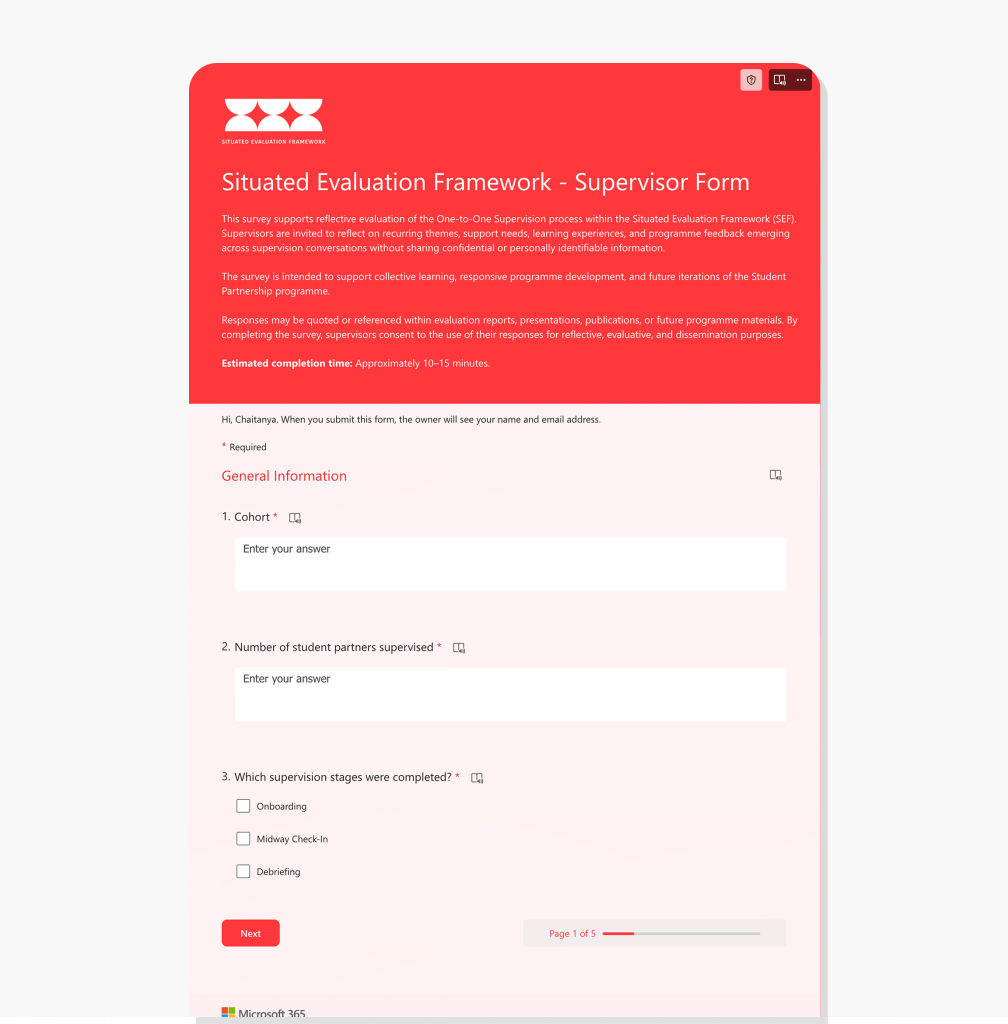
An optional Supervisor Reflective Evaluation Survey template is also included within the framework to support the documentation of reflections, recurring themes, recommendations, and overall observations emerging throughout the supervision process.