
What is Evaluation?
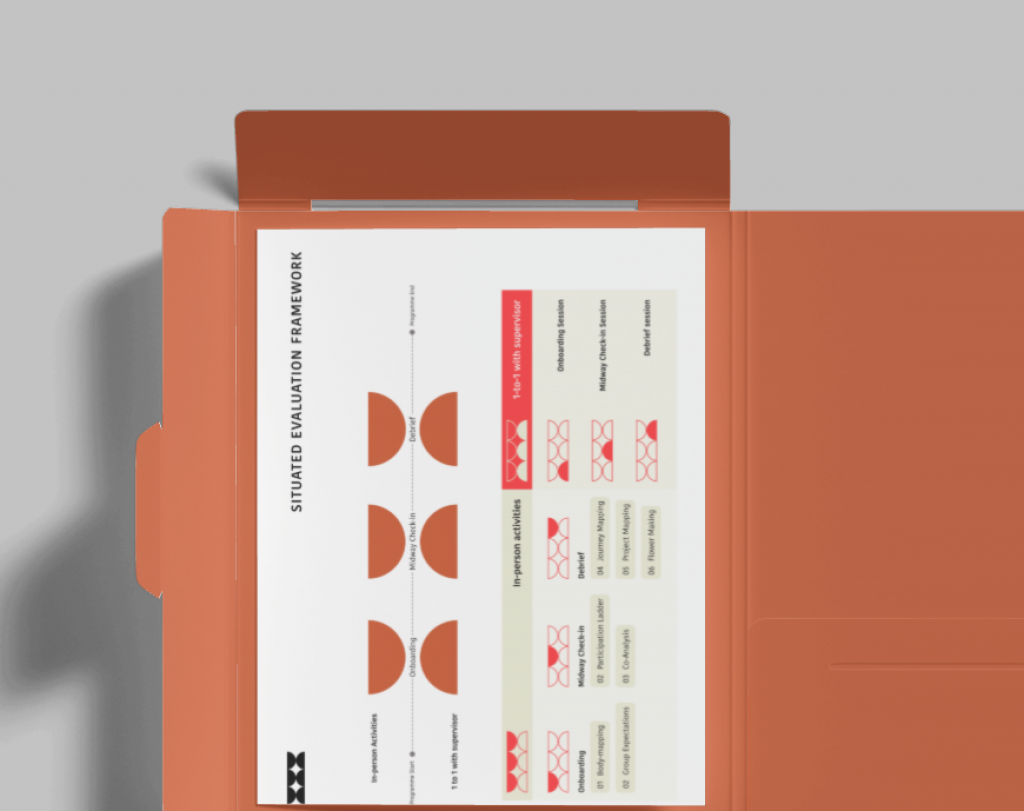
The Situated Evaluation Framework (SEF) approaches evaluation as a participatory, reflective, and collaborative process grounded in dialogue, lived experience, and collective meaning-making. Rather than treating evaluation as a purely administrative, extractive, or outcome-focused exercise, this framework understands evaluation as an ongoing practice of learning, relationship-building, critical reflection, and shared interpretation.
Our Approach
01 Situated in Lived Experiences
The SEF recognises that student partners’ lived experiences, shaped by their identities, relationships, and communities, are valuable and essential evidence for understanding the complexities and impacts of partnership work.
02 Creative Expression
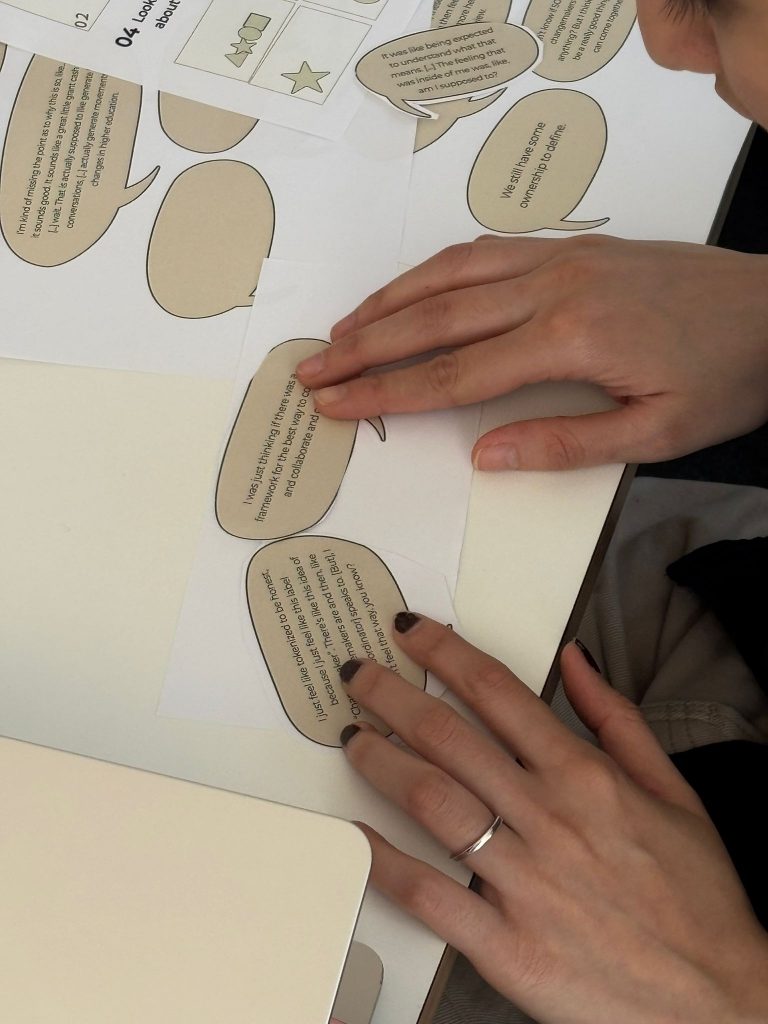
While traditional evaluation is text heavy, privileging written responses, this framework draws on participatory, arts-based, feminist, and decolonial approaches to evaluation and learning. Across the activities, participants are encouraged to engage through storytelling, dialogue, visual mapping, speculative thinking, and collaborative reflection. These methods create opportunities for participants to explore experiences that may be difficult to capture through conventional evaluation approaches alone.
03 Collective Reflection
The framework also approaches reflection as a collective analytical practice instead of expecting participants to already know what they have to fund out or what they learned. Through activities such as Body Mapping, Participation Ladders, and Scenario Building, participants are invited not only to reflect on individual experiences, but also to collectively interpret patterns, relationships, institutional dynamics, and possibilities for change emerging across the programme.
04 Speculative Thinking
Storytelling and speculative thinking are used throughout the framework as tools for collective sense-making rather than just focusing on individual feedback. Scenarios, narratives, and creative exercises allow participants to explore tensions, imagine possible futures, and critically engage with systems, relationships, participation, and institutional structures in ways that may feel more accessible, relational, and emotionally grounded.
05 Positionality
The SEF acknowledges that participation, collaboration, and evaluation are shaped by power relations and institutional contexts. As such, the framework encourages critical reflection on whose voices are heard, how decisions are made, what forms of knowledge are recognised, and how collaboration and care are practiced within student partnership work.
06 Multiple Perspectives
Importantly, this framework is not intended to produce a single objective interpretation of participants’ experiences. Instead, it supports the development of multiple perspectives, shared understanding, and collective learning. Meaning is understood as something that is shaped collaboratively through dialogue, reflection, creativity, and community.
07 Adaptable
The SEF is designed to be flexible and adaptable across different programmes, communities, and institutional contexts. Facilitators and participants are encouraged to adapt activities, prompts, timings, and methods in ways that best support accessibility, inclusion, collective care, and meaningful participation.
Overview
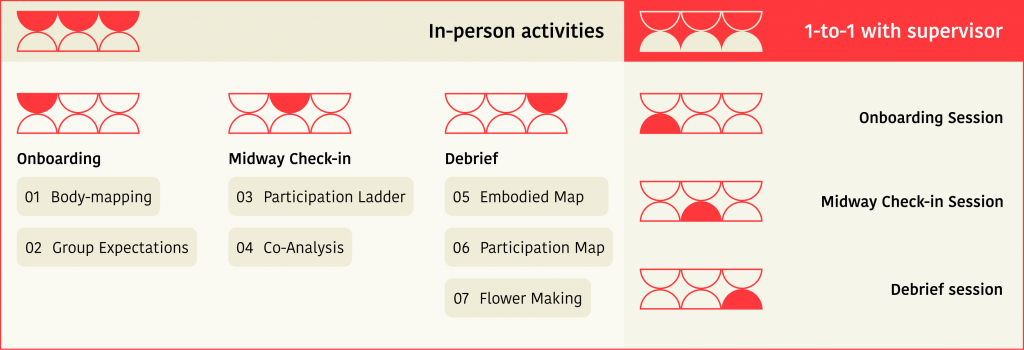
The Situated Evaluation Framework (SEF) is a resource designed to support reflective, creative, and collaborative evaluation within student partner programmes. The framework consists of In-Person Activities, designed for student partners to facilitate autonomously or in collaboration with an external partner-facilitator, and One-to-One Supervision Activities, facilitated by the student partners’ supervisor to support reflection, documentation, and ongoing evaluation.
Goals
The goal of this framework is to support student partners and staff in understanding their impact and adjust their direction towards achieving short-, medium-, and long-term outcomes through reflective, collaborative, and participatory evaluation practices.

Short-Term Goals
- Dialogue across people, times, spaces, and methods
- A strengthened sense of collectivity
- Recognition and inclusion of diverse forms of knowledge
- Development of diverse and collective narratives
- Collective action and collaboration
- Professional development
- Personal development
- Community-building
- A sense of validation and recognition

Mid-Term Goals
- Embedded student voice within institutional practices
- More structured and coordinated advocacy
- Development of relevant and responsive policies
- Evaluation narratives that reflect lived experiences and diverse perspectives
- Career advancement and enhancement
- Increased professional recognition
- Greater self-confidence and agency
- A stronger sense of community identity

Long-Term Goals
- A more relevant, inclusive, equitable, and decolonial higher education


SEF Team
The SEF was developed through the LCC Changemakers programme supervised by Kevin J Brazant, a student-partnership initiative at London College of Communication that supports collaborative work between students and staff to explore and support institutional, educational, and social change within higher education.
The framework was co-developed by student partners across two Changemakers cohorts through a participatory and iterative design process grounded in reflection, facilitation, storytelling, and collective evaluation practices. The framework therefore emerges directly from the lived experiences, insights, and collaborative work of student partners engaging in partnership practice themselves.





Additional contributions and feedback were provided by the wider LCC Changemakers community and supporters, including: Terry Finnigan, Adam Ramejkis, Roxanne Peters, Alejandra Nava, Anoushka Badola, Cassia Clarke, Farid Tan Bin Hasyim Tan, Hanna Cox, Hanjun Shi, Lucy Jessica Coney, Marryam Khan, Nieves Mingueza, Sara Keserović, and Slavi Kaloferov.
Funding
The creation of this framework has been supported by the LCC Climate, Racial and Social Justice fund.